If you are a practicing therapist, counsellor or psychologist in India exploring trauma training, the landscape can be confusing. University programs offer postgraduate diplomas. Public-health institutions offer certifications focused on specific populations. Generic trauma-awareness programs proliferate. Each has its place, but they answer different questions, and the differences matter when you are choosing where to invest a year of your professional life.
This post sets out, plainly, how the Wellness Space evidence-based psychotherapy training compares to the existing alternatives you are likely to be evaluating: university trauma diplomas, government or public-health trauma certifications, and short trauma-awareness courses. Every point is anchored in what each program publicly publishes about itself.
The three types of training you’ll find in India
- University postgraduate diplomas in trauma-focused therapy. These run for a year, are academic in posture, and cover a broad survey of trauma modalities (EMDR, IFS, parts work, somatic, CBT) at a theoretical level. They are valuable for foundational orientation. Their own course descriptions usually state that they introduce the theoretical bases of these interventions, but do not provide modality-specific certification — practitioners are encouraged to seek it separately through the relevant certifying organizations. Eligibility is usually restricted to M.Phil Clinical Psychology, MD Psychiatry, or a Master’s in Psychology with significant prior experience.
- Government or public-health trauma certifications. Often targeted to specific populations (for example, individuals facing gender-based violence) or specific service settings (One Stop Centres, helpline counsellors, paramedical staff). The clinical content is grounded in generic counselling skills — distress tolerance, anger management, behavioural activation, crisis intervention, and supportive counselling. These are excellent at what they do but are not modality certifications in trauma protocols.
- Short trauma-awareness or trauma-informed care courses. Six-month or shorter, designed to upskill clinicians of various backgrounds in a trauma-informed orientation. Useful as orientation; not designed to certify you in a specific therapy modality.
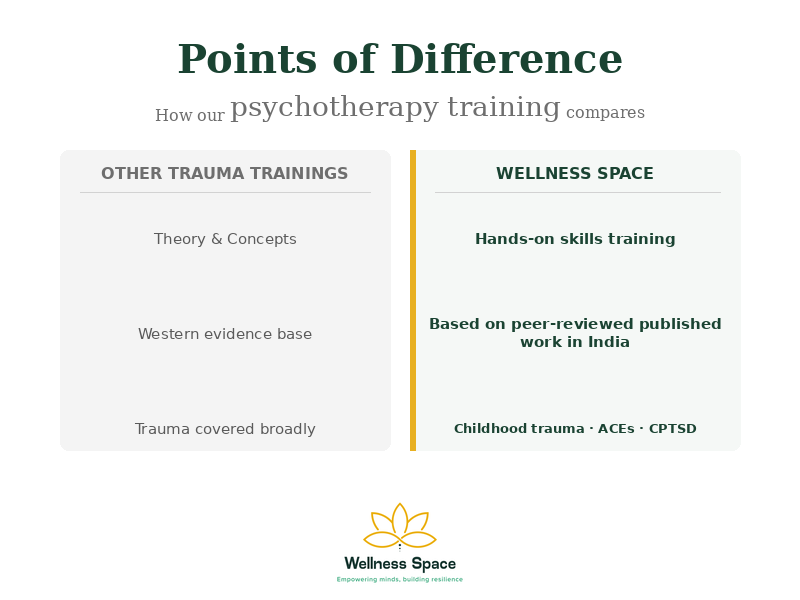 Wellness Space sits in a different category. Client-centric and modality-based clinical certification, built on our own published research on Indian populations or existing and proven global evidence. The rest of this post explains what that means in practice.
Seven points of difference
1. Modality certification, not theoretical introduction
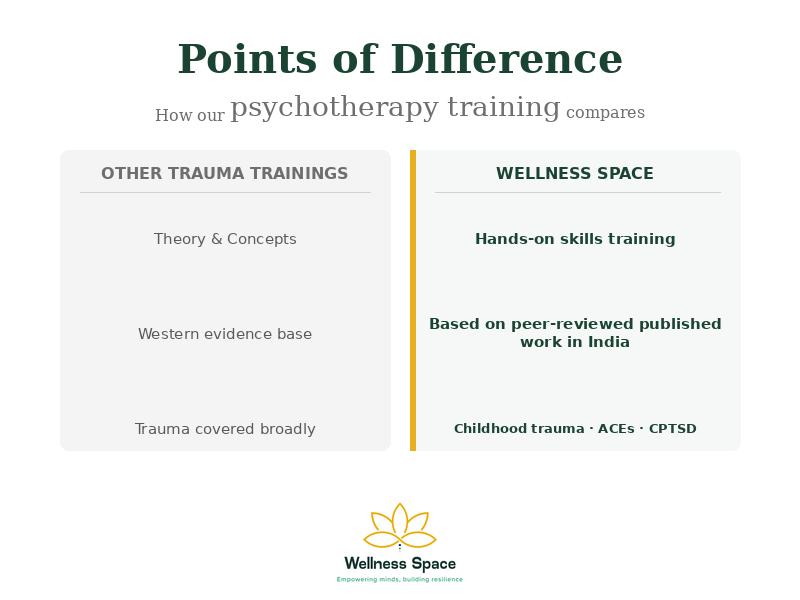
This is the largest single difference. Most Indian trauma diplomas explicitly state that they introduce the theoretical bases of modalities like EMDR and IFS, but do not provide certification in them — practitioners must pursue that separately. Wellness Space does the opposite. We teach the modalities clinically, with hands-on skill-building, supervised practice, and accreditation upon completion. By the time you finish, you can deliver:
- Reconsolidation of Traumatic Memories (RTM) — the dissociated-recall protocol for PTSD and Complex PTSD
- Inner Child Integration Therapy — our flagship modality, published in the International Journal of Regression Therapy
- Clinical Hypnotherapy — including affect bridges, age regression, and parts work in trance
- Parts Work and Gestalt techniques — taught across Modules 1, 3 and 4
- Memory Mirror, Cartesian Questioning, and the Chunk Up-Down Model — the integrative cognitive tools
These are clinical skills you walk out to work and not concepts you have been introduced to.
2. Built on our own published research on Indian populations
Most trauma curricula in India draw on Western evidence, populations, presentations, and research contexts that do not always map onto the clients you actually see. We have spent the last decade building an Indian evidence base. Fourteen peer-reviewed studies, including:
- A 909-person cross-sectional study published in the Indian Journal of Community Medicine established a dose-response relationship between Adverse Childhood Experiences and adult anxiety and depression in Indian adults. Several additional research papers on childhood trauma.
- Four peer-reviewed papers on RTM — including a pilot quasi-experimental study (Trivedi et al., 2024, European Journal of Trauma & Dissociation) showing statistically significant Complex PTSD reduction at one and three months (p<.01).
- Our inner child integration therapy effectiveness paper shows significant reductions in anxiety, depression, and sleep disturbance in Indian adults with unresolved childhood trauma.
- Case-study work covering RTM for CPTSD, PTSD with Prolonged Grief Disorder, and trauma-informed psychotherapy for CPTSD in young adults.
The training is the clinical implementation of this research. You learn what we have published, with the same instruments and protocols our papers describe.
3. Indian-adapted assessment tools, not just adopted Western instruments
Where standard Western tools fall short for Indian clinical populations, we have built our own — validated and published. Trainees graduate fluent in:
- Trivedi ACE-14 Assessment™ — our India-specific Adverse Childhood Experiences assessment, capturing forms of childhood adversity (joint-family dynamics, comparison-based shaming, abuse hidden under the language of discipline) that the original ACE-10 does not surface.
- PsyKundali™ clinical dashboard — the outcome-tracking system used in our published research, integrating ITQ (CPTSD), GAD-7 (anxiety), MDI (depression), ACE-14, SBQ-R (suicide risk), sleep and well-being.
- PsyComplexity Scale™ — for case formulation and pacing.
- Trivedi FLIP Model™ — body-based regulation taught for client stabilization.
These are not used elsewhere because they are ours. They are taught and certified only in this program.
4. Childhood trauma and ACEs as the unifying frame
University programs treat trauma broadly across the lifespan. Government programs focus on specific populations (GBV, IPV). Wellness Space training treats Adverse Childhood Experiences as the central explanatory variable, the lens through which adult anxiety, depression, sleep disturbance, somatic presentation, and Complex PTSD are understood. This is not a stylistic choice. It is what our extensive research has established in Indian adults: a clear dose-response between childhood adversity and adult mental health load.
If your client population is Indian adults with unexplained chronic anxiety, low self-worth, relationship patterns that do not respond to standard CBT, or sleep disturbance that persists despite medication, ACEs are almost certainly the missing variable. This training teaches you to find them, measure them, and treat them.
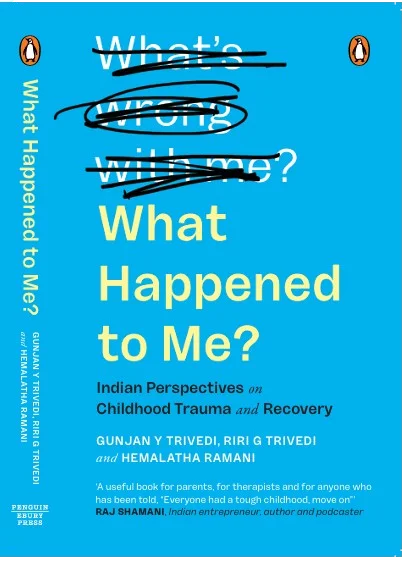
5. Two Penguin India books, a public-facing translation of the research
No other Indian psychotherapy training program has this. Our research has been translated into two books published by Penguin Random House India:
- What Happened to Me? vs What’s Wrong with Me? (Ebury Press, 2026) — The childhood trauma book, the public-facing translation of our ACE and CPTSD research.
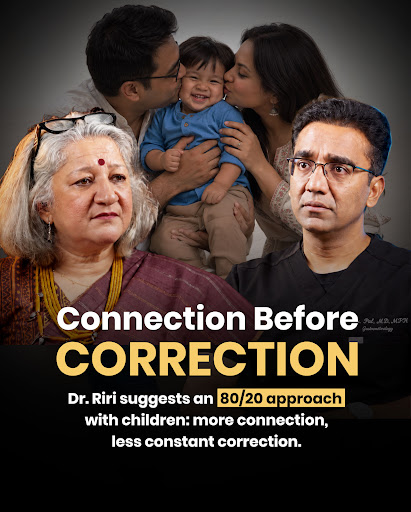
- This Book Won’t Teach You Parenting (Penguin Random House India) — the prevention and intergenerational angle, by our co-founder Dr Riri G Trivedi.
Both books are recommended reading for trainees and form part of how the research reaches the public. For practitioners, they are also useful for clinical bibliotherapy, you can recommend them to clients and parents as part of treatment.
6. Accreditations, not one Indian certificate
Our established set of publications is our most unique form of accreditation about what we teach. The publications cover a range of areas from ACEs, anxiety, depression, insomnia, PTSD, CPTSD, loneliness, PCEs (Positive childhood experiences) and so on. In addition our training is the only evidence-based psychotherapy training program in India accredited by all three of:
- EARTh — Earth Association for Regression Therapy
- IMDHA — International Medical and Dental Hypnotherapy Association
- IPHM — International Practitioners of Holistic Medicine
7. Open practitioner pathway
University trauma diplomas in India typically restrict eligibility to M.Phil Clinical Psychology, MD Psychiatry, or Master’s in Psychology with two or more years of experience. This excludes most of India’s actual mental health workforce — counsellors, hypnotherapists, NLP practitioners, regression therapists, coaches, and integrative practitioners who provide most front-line care in a country with an acute clinical psychologist shortage.
Wellness Space welcomes these practitioners. The six-module structure means those with existing certifications in psychotherapy, hypnotherapy, NLP or regression therapy can join directly at later modules. The training is designed to upskill the existing workforce, not just the slice with M.Phil credentials.
Side-by-side comparison
The table below summarizes how the Wellness Space training compares to the dominant alternatives. We have characterized competitor programs by type rather than name, because the patterns hold across the category.
Dimension | University / Government Trauma Programs | Wellness Space |
Format | Academic diploma or public-health certification; introduces theory of modalities | Modality-based clinical certification; you learn the protocols, under supervision, with assessment and based on strong scientific evidence, with focus on addressing the problem. |
Modality certification | Theoretical bases of EMDR, IFS, and Parts Work introduced; specific certifications must be sought separately | Direct certification covering techniques such as RTM, Inner Child Integration Therapy, Clinical Hypnotherapy, Parts Work, Gestalt — internationally accredited |
Eligibility | Typically restricted to M.Phil. Clinical Psychology, MD Psychiatry, or Masters in Psychology with experience | Psychologists, counsellors, hypnotherapists, NLP practitioners, regression therapists, and coaches with a relevant background |
Research base | Curriculum drawn from Western evidence-based; institutional research output broad, not modality-specific to course | Built on several peer-reviewed studies by our team — on Indian populations, including RTM, Inner Child, CPTSD and several ACE studies |
Indian-adapted tools | Generally uses standard Western instruments | Trivedi ACE-14 Assessment™, PsyKundali™ outcome dashboard, PsyComplexity Scale™, Trivedi FLIP Model™ |
Cultural-clinical bridge | Trauma-informed lens, intersectional or feminist frameworks | Pancha Kosha Trauma Framework — Indian Knowledge System integrated with modern neuroscience |
Outcome measurement | Assessment for treatment planning; not a session-by-session dashboard | PsyKundali™ tracks ITQ (CPTSD), WHO-5, UCLA, BRS, GAD-7, MDI, ACE-14, SBQ-R across sessions |
CPTSD specificity | Trauma covered broadly; CPTSD not consistently distinguished from PTSD | ICD-11 CPTSD via ITQ is core; published RTM-for-CPTSD pilot shows p<.01 reduction at 1 and 3 months |
Public-facing translation | Not applicable | Two Penguin India books: What Happened to Me? vs What’s Wrong with Me? And This Book Won’t Teach You Parenting |
Accreditation | Indian academic body diploma/certificate | Scientific, published evidence is our best accreditation ! Additional, we also extend to EARTh + IMDHA + IPHM — three international accreditations |
Who this training is for
If you are:
- A psychologist or counsellor who believes that academic training that does not sufficiently equip you to deliver modality-specific trauma work, based on cliet needs
- A hypnotherapist, NLP practitioner or regression therapist wanting to add RTM and inner child integration to your toolkit with international accreditation
- A mental health professional working with clients who present with childhood trauma, ACEs, PTSD or Complex PTSD and want measurable outcomes,
- A coach or integrative practitioner ready to move from generic wellness work into clinically grounded trauma practice
Then this is the training built for you.
If you have to pick one thing that makes Wellness Space different, it is the only Indian psychotherapy training program where what you learn, the tools you use, and the books you can hand your clients all come from the same body of published research — done here, on Indian populations, by the same team that teaches the training.
Where to find out more
- Evidence-based Psychotherapy Training
- Inner child therapy
- CPTSD Channel YT
- RTM and CPTSD research
- CPTSD research hub
- ACE-depression-anxiety publication
More details:
Our Book on childhood trauma has more details:
The book covers all the concepts, several case studies and practices taught in our evidence-based psychotherapy program.
Click here to purchase the book: What Happened to Me?