Trivedi FLIP Model™- A Body-First Approach to Trauma Recovery
From “What’s wrong with me?” to “What happened to me?” — the single shift that changes everything.
The Trivedi FLIP Model™ is a body-first trauma recovery framework that reverses the conventional therapy sequence — beginning with physiology, not thoughts — to help people move from self-blame to self-understanding. The idea is based on the Pancha Kosha Trauma Framework™ developed by Dr Gunjan Y Trivedi. It integrates a model-science perspective, ancient yogic concepts (based on Pranayama), and clinical experience with self-regulation for trauma recovery.
Why most trauma therapy starts in the wrong place
Conventional approaches — talk therapy chief among them — try to change reactions by changing behaviour. But anyone who has lived through a trigger knows the truth: by the time you’ve thought about how you should respond, your body has already responded. The pounding heart, the held breath, the words you wish you hadn’t said.
The familiar admission says it best: “I knew I was overreacting, but couldn’t help it.”
This is the gap the Trivedi FLIP Model™ addresses.
The flip: reversing the chain
Most trauma frameworks follow the same sequence:
Thoughts → Emotions → Body → Action → Result
The Trivedi FLIP Model™ reverses it:
Physiology (body) → Emotions → Thoughts → Action → Result
The reasoning is practical. The body is easier to reach than the mind. It can be observed, measured, and worked with concretely. Slowing the breath is far simpler than redirecting a thought on demand.
This single reversal changes the central question of trauma recovery. Instead of asking how do I control my thoughts?, You begin to ask how do I regulate my state?
“You can’t think your way out of a state your body is still in.”
Watch: Why trauma therapy can make you feel worse, and how the FLIP Model changes that.
Dr Gunjan Y Trivedi explains why talking through painful memories can re-traumatise, and how starting with the body makes recovery safer.
Contents: Introduction · What happened to me vs what is wrong with me · The Trivedi FLIP Model · Revisiting childhood trauma
What grounds the FLIP Model
The Trivedi FLIP Model™ is built on years of psychotherapy practice, behavioural observation, and trauma recovery work at Wellness Space. It draws on:
- Neuroscience — how the brain encodes threat, memory, and safety
- Emotional regulation — working with feelings rather than being flooded by them
- Body-based awareness — recognising that trauma lives in the nervous system, not just the story
- Pancha Kosha Trauma Framework™ — how trauma touches multiple layers of being
The full mechanism — including how heart rhythm, the vagus nerve, and breathing patterns work together to shift inner state — is detailed in our book What Happened to Me? and taught experientially in Module 1.
Who the FLIP Model is for
- Anyone caught in cycles of overreaction or shutdown, where insight alone hasn’t translated into change
- Those navigating trauma, anxiety, or chronic stress, where talk-based approaches have offered understanding but a limited shift in how the body responds to triggers
- Clients and practitioners seeking a body-first path to recovery
- Therapists, coaches, and wellness professionals wanting a structured way to help clients move from “What’s wrong with me?” to “What happened to me?”
Frequently asked questions
Q. Is the FLIP Model a meditation or breathing technique? The Trivedi FLIP Model™ is a framework — a way of understanding how change actually happens in trauma recovery. Specific practices (breathing, humming, gentle movement) are tools that operate within it. The book and Module 1 walk through these in detail. The process covered in the book explains how to integrate the concept and practices based on the trauma recovery model.
Q. Can I really shift my thoughts by changing my breath? Yes — though indirectly. The heart and brain are in constant two-way conversation, and the body’s state shapes what the mind produces. The science behind why this works is unpacked in the book.
Q. How long does it take to learn the FLIP Model? The reversal itself is grasped in minutes. Building it into a reliable practice takes a couple of sessions of guided work —exactly what Module 1 (Foundation — The Journey Within) is designed for.
Q. Do I need to be in therapy already? No. The FLIP Model works as a standalone foundation for self-regulation and as a starting point for those entering trauma therapy.
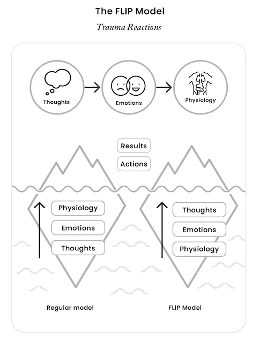
Figure 1: The Trivedi FLIP Model™
Learn the full FLIP Model
The Trivedi FLIP Model™ is one of the foundational frameworks taught in our Evidence-based Psychotherapy modules (1–6).
Module 1 — Foundation: The Journey Within integrates the FLIP into a structured self-regulation practice called The SEE Protocol for Self-Hypnosis.
The complete model — including the neuroscience, the heart-coherence research, and the body-based practices — is detailed in our book What Happened to Me?