
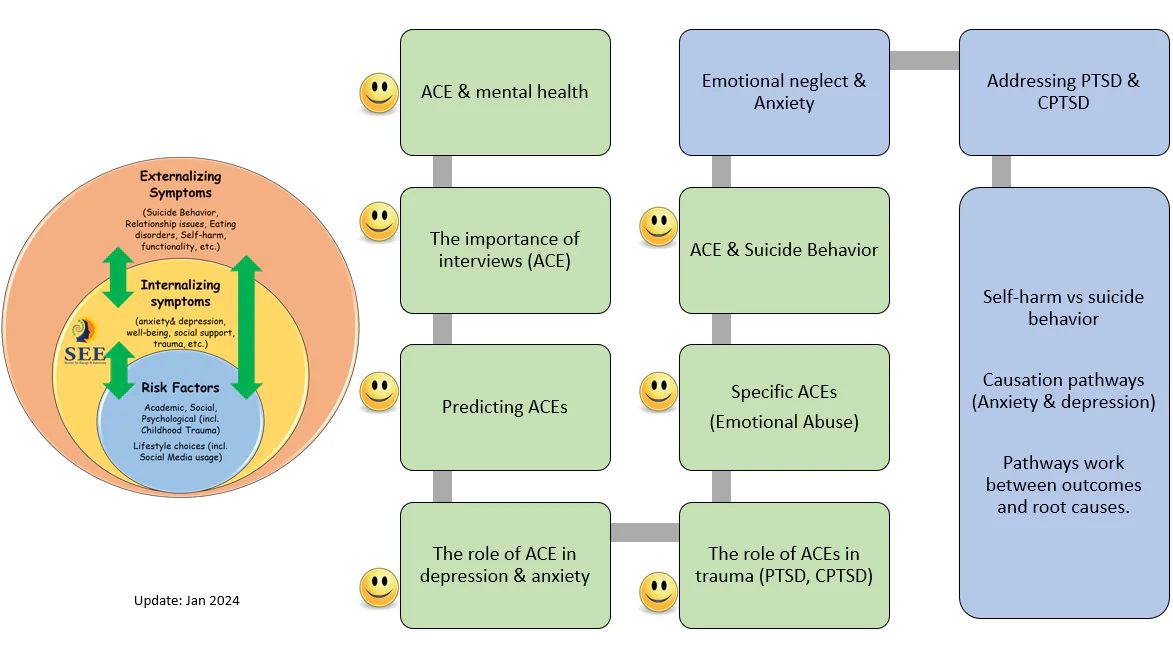
At Wellness Space, over the past several years, we have worked on understanding the root causes that lead to internalizing and externalizing symptoms. One of the core issues or root causes is exposure to repeated trauma of high intensity during childhood. Despite the extensive global evidence, there is limited childhood trauma research in India. Hence, we decided to pursue it. At the moment, we have extensive published evidence supporting the role of childhood trauma as a significant risk factor in several internalizing issues (Such as depression and anxiety, insomnia, etc.) and externalizing issues (including suicide behaviour, relationship issues and more).
The visual below shows all the childhood trauma research in India that we have published in “green” boxes and our “work-in-progress” in “blue” boxes. The list of currently published articles with links (where available) is also provided. One of the objectives is to increase awareness across the country about the role of childhood trauma and eventually provide guidance to parents, caregivers, etc. We also take this opportunity to thank our mentors and co-authors (The Society for Energy & Emotions, Wellness Space) for guiding us so far.
Read more about What Happened to Me?, our evidence-based childhood trauma book for Indian readers.
By Dr Gunjan Y Trivedi, Dr Riri G Trivedi and Dr Hemalatha Ramani— based on 14 published studies and years of clinical work at Wellness Space. Covering ACEs, their impact on adult mental health, and evidence-based pathways to recovery or healing in the Indian context.
Amazon link to purchase the book
Research on Childhood Trauma (at Wellness Space) published so far (Updated May 2025)
- Adverse Childhood Experiences & Mental Health–the urgent need for public health intervention in India. Journal of preventive medicine and hygiene, 62(3), E728.
- Trivedi, G. Y., Ramani, H., Trivedi, R. G., Kumar, A., & Kathirvel, S. (2023). A pilot study to understand the presence of ACE in adults with post-traumatic stress disorders at a well-being centre in India. European Journal of Trauma & Dissociation, 7(4), 100355.
- K Rao, A., Y Trivedi, G., Bajpai, A., Singh Chouhan, G., G Trivedi, R., Kumar, A., … & Ramani, H. (2023, July). Predicting Adverse Childhood Experiences via Machine Learning Ensembles. In Proceedings of the 16th International Conference on PErvasive Technologies Related to Assistive Environments (pp. 773-779).
- Trivedi, R. G., Kumar, A., Ramani, H., Trivedi, G. Y., & Kumar, S. (2023). The Insidious Nature of Childhood Emotional Abuse. International Journal of Indian Psychȯlogy, 11(4).
- Trivedi, G. Y., Ramani, D. H., Trivedi, R. G., Kumar, D. A., & Soundappan, D. K. (2024). The importance of personal interviews in assessing Adverse Childhood Experiences (ACE) in India.
- Rao, A. K., Trivedi, G. Y., Trivedi, R. G., Bajpai, A., Chauhan, G. S., Menon, V. K., … & Dutt, V. (2024). Predicting suicidal behavior among Indian adults using childhood trauma, mental health questionnaires and machine learning cascade ensembles. arXiv preprint arXiv:2401.17705.
- Trivedi, Riri G.; Kumar, Anita; Soundappan, Kathirvel1; Trivedi, Gunjan Y.2; Ramani, Hemalatha2; Kumar, Saurabh. Association between Adverse Childhood Experiences and Internalizing Symptoms in Adults at a Wellness Centre in India. Indian Journal of Community Medicine ():10.4103/ijcm.ijcm_419_23, October 08, 2024. | DOI: 10.4103/ijcm.ijcm_419_23
- Trivedi G. Y. (2024). Reconsolidation of Traumatic Memories in the Treatment of Complex Post-traumatic Stress Disorder (CPTSD): A Case Study. Cureus, 16(9), e68927. https://doi.org/10.7759/cureus.68927
- Trivedi, G. Y., Pandya, N., Thakore, P., Ramani, H., Trivedi, R. G., & Kathirvel, S. (2024). The effectiveness of Reconsolidation of Traumatic Memories for Complex PTSD–A pilot quasi-experimental study from a wellness centre in India. European Journal of Trauma & Dissociation, 100480.
- Naik, V., Trivedi, G., & Trivedi, R. G. (2024). Navigating generational patterns: how childhood trauma shapes authoritative parenting practices in Indian families. Int J Indian Psychȯl, 12(2), 4179-89.
- Trivedi, G. Y., Surana, P., Pandya, N., Patel, N., Trivedi, R. G., Kathirvel, S., & Kumar, A. (2025). Psychometric properties of expanded Adverse Childhood Experiences Assessment Questionnaire at a wellness centre in India. Asian Journal of Psychiatry, 104523.
- Trivedi, G. Y. (2026). Positive childhood experiences are independently associated with adult resilience after accounting for adverse childhood experiences: A cross-sectional study in India. Acta Psychologica, 267, 107028.
- Trivedi, G., Pandya, N., Thakore, P., Ramani, H., & Patel, N. (2026). A Structural Equation Modelling Approach to Understand the Associations Between Childhood Emotional Maltreatment, Loneliness, Depression and Disturbances in Self-Organization at a Wellness Centre in India. International Journal on Child Maltreatment: Research, Policy and Practice, 9(1), 107-128.
- Shetty, Y. N., Trivedi, G. Y., & Bhatia, G. (2026). Trauma-Informed Psychotherapy for Complex Post-traumatic Stress Disorder in a Young Adult Woman: A Case Report. Cureus, 18(3), e105984. https://doi.org/10.7759/cureus.105984
The above excludes (a) published case studies, and (b) articles published in the International Journal of Regression Therapy (EARTh funded projects)
Recent work (Updated Nov 2024)
Some of the recent work on “childhood trauma”, done in India is highlighted below
Publication – Adverse childhood experiences (ACEs or childhood trauma) and depression/anxiety (IJCM)
Work-in-progress
At present, we continue to work on linking the risk factors (specific childhood trauma components) with several internalizing and externalizing issues. Specifically, we are exploring the drivers of self-harm so that parents can identify and work on that for prevention and management. We are also exploring the role of specific childhood trauma components in anxiety. We have also been exploring structural equation modelling to understand several pathways between risk factors (trauma), internalizing issues (e.g. depression) and externalizing issues (e.g. suicide behaviour or functional impairment). We have done extensive work on assessing and addressing complex PTSD (Post Traumatic Stress Disorder)) using Reconsolidation of Traumatic Memories and Inner Child Therapy methodologies (For details – explore our training module #3 of 6 on “Inner Child” ) to address the impact of childhood trauma or PTSD. We expect some of this work to be published over the next few years.
From Research to Healing
Our research directly informs how we work with clients. If you or someone you know has experienced childhood trauma and is seeking help, here is how Wellness Space can support you:
- For individuals seeking therapy: Inner Child Therapy in India — evidence-based, measurable, available online across India
- For therapists seeking training: Inner Child Therapy Certification — the only EARTh, IMDHA and IPHM accredited programme in India
- For parents: Parental Consultation — understanding how your childhood shapes your parenting
Our approach to linking risk factors to internalisation and externalisation issues is highlighted in a series of 3 videos presented by Dr Gunjan Y Trivedi.
Video 1 of 3:
Video 2 of 3:
Video 3 of 3: