
Individual Therapy | Inner Child Therapy & Trauma Recovery

Individual Psychotherapy & Coaching
We offer personalised 1:1 consultations tailored to personal and parental needs, helping individuals navigate life’s challenges with clarity and confidence. Our core specialisation is inner child therapy— an evidence-based approach to recovering from childhood trauma that is available in-person in Ahmedabad and online across India. The approach also includes several other interventions, including but not limited to reconsolidation of traumatic memories (for PTSD and CPTSD), Relationship Drama, Gestalt (empty chair) and more.
We also offer group therapy sessions for students struggling with mental health issues. Our evidence-based therapies and engaging workshops provide tools for growth, resilience, and emotional well-being. Together, we empower individuals to overcome obstacles and thrive.
Our Therapeutic Approaches
Every person arrives with a different history, so we don’t apply one method to everyone. After your initial consultation, we recommend the approach — or combination — best suited to what you’re carrying.
Inner Child Therapy
Our core specialisation. Many adult patterns — people-pleasing, emotional shutdown, recurring relationship conflict — trace back to unmet needs in childhood. Inner child work locates those origins and resolves them at the source rather than managing the symptoms.
Reconsolidation of Traumatic Memories (RTM)
A structured, evidence-based protocol for PTSD and CPTSD. RTM works by reprocessing a traumatic memory, so it loses its emotional charge, typically within a small number of sessions. It does not require you to relive the event in detail.
Gestalt and Empty Chair Work
Used where there is unfinished business — with a parent, a partner, a version of yourself. The empty chair technique makes the unspoken conversation possible, allowing you to say what was never said and hear what was never answered.
Relationship Dialogue Work
For recurring conflict patterns that persist through changes in partner. We map the roles you find yourself repeating and trace where you learned them, so the pattern becomes visible and therefore changeable. We have used this patten for grief work also.
Hypnotherapy
A focused, relaxed state that allows access to material below ordinary awareness. Used selectively, alongside other approaches, where it suits the person and the presenting issue.
Self-Regulation Skills
Alongside any of the above, your therapist teaches practical techniques for managing emotional states between sessions — and after therapy ends. Independence is the goal.
Why “Evidence-Based” Matters Here
The phrase gets used loosely in Indian mental health. For us it means three specific things.
The research is ours, not borrowed. Both founders hold PhDs in this field and publish in peer-reviewed journals on childhood trauma and mental health. Dr Gunjan Y Trivedi’s research centres on heart rate variability, mind-body interventions, childhood trauma and complex PTSD (Google Scholar · ResearchGate). Dr Riri G Trivedi’s doctoral thesis examined adverse childhood experiences and their relationship with anxiety, depression and subjective well-being among adults in India (Google Scholar · ResearchGate).
Your progress is measured. Self-assessment forms at sessions 4, 8 and 12, plus follow-up calls from our psychologist. If something isn’t working, the data shows it — not a year from now, but within weeks.
We plan to end. Once your scores improve and you feel ready, we reduce session frequency deliberately. Open-ended therapy with no exit is not a model we’re interested in.


Individual Therapy
Our team understands and identifies each individual’s unique needs. After an initial consultation, we recommend the best therapeutic approach to support your resilience, growth, and well-being. For adults dealing with anxiety, depression, relationship patterns, or unexplained emotional blocks rooted in childhood, we also specialise in (a) reconsolidation of traumatic memories, (b) inner child therapy in India and similar approaches in India backed by peer-reviewed published research.
Our book What Happened to Me? covers this approach in depth — a useful starting point if you’re not ready to book a session yet.
Parental Consultation
Parenting style and emotional health are key to shaping your child’s future. We provide guidance to help you understand how these factors influence your child’s development and behaviour. Together, we’ll explore practical solutions that strengthen your parenting and support your child’s well-being.
If you’d like to explore this before booking, This Book Won’t Teach You Parenting covers much of the same ground.
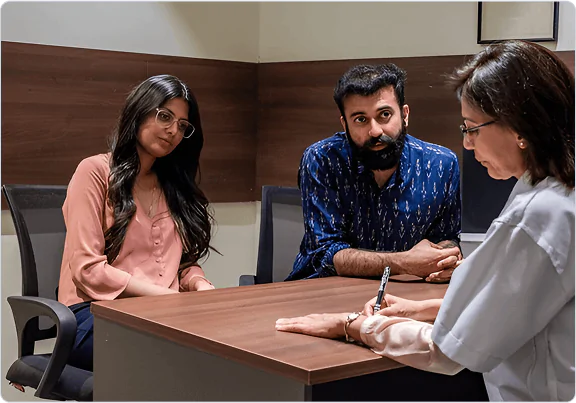

Student-Focused Group Therapy
We offer group therapy tailored to students facing mental health challenges, including stress, anxiety, and adjustment issues.
Individual Therapy & Coaching


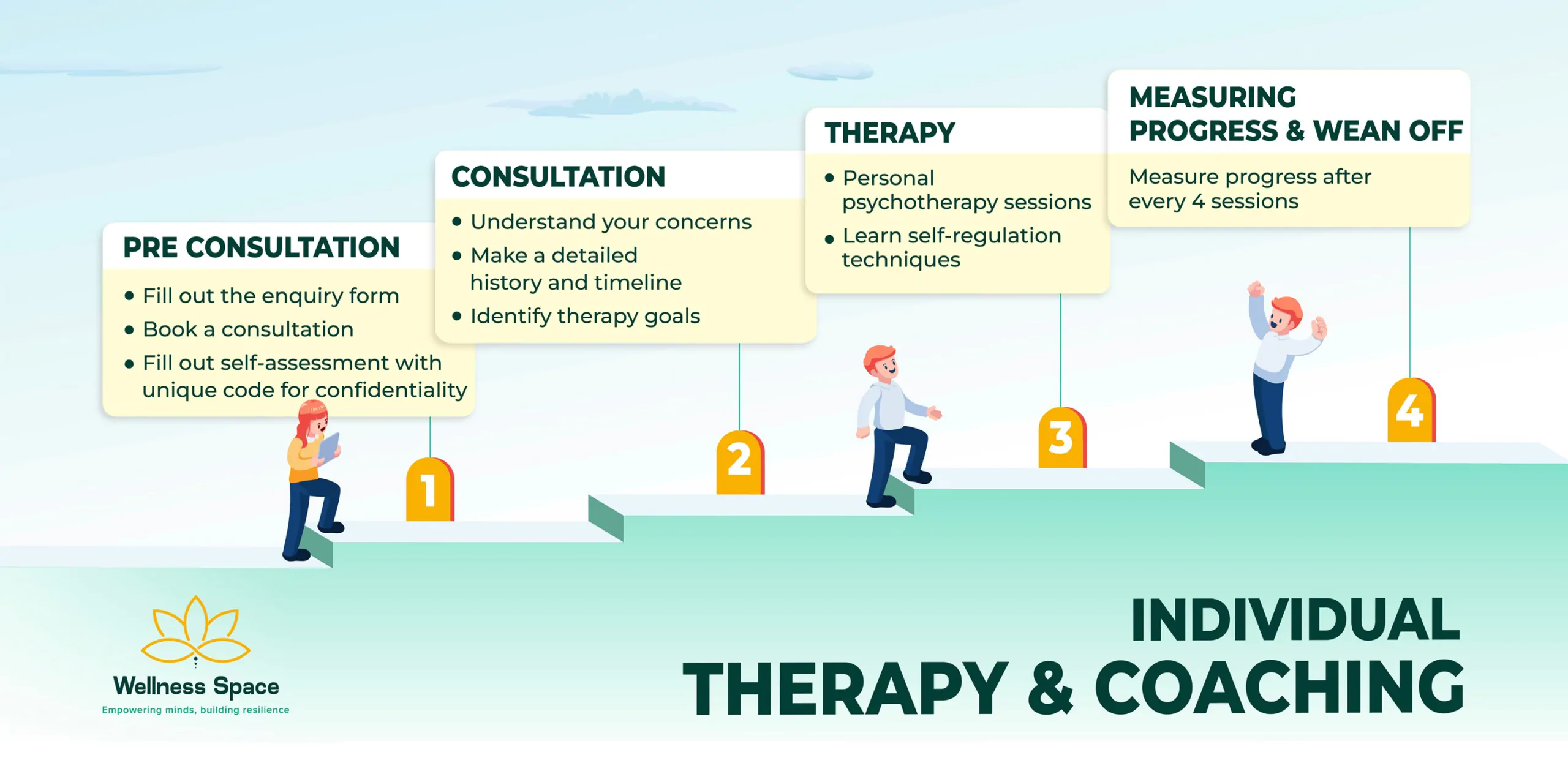
I Pre Consultation
Submit Your Inquiry
Start by filling out the inquiry form in the “Enquire Now” section with the necessary information
Book Your Consultation
Once we receive your inquiry, we’ll respond with a list of available therapists(sliding scale) and payment details according to your needs. We will assign a Unique Client Code under which all your details will be maintained – to maintain confidentiality. To confirm your booking, you simply need to make the payment and schedule your session at a mutually convenient time.
Fill up the forms
Once consultation is scheduled, we shall send a list of forms to be filled out for self-assessment as well as a Consent form which has to be filled up using the Unique Client Code assigned to you. If you are a minor below 18 yrs of age, you will require a consent form to be signed by a parent or guardian. We hold Personal Privacy in high regard – we maintain a very high standard of personal privacy – hence we assign a Client code to you under which all the information will be saved. This code has to be used for filling up all assessment forms and for therapy notes, progress tracking etc.
II Consultation
The 1:1 consultation with our therapist will include understanding your problem, getting a complete history of your past experiences and mapping them on a time line and identifying the therapy focus. If required, we may request you to fill out more forms after the consultation (in some high-risk cases) before we start therapy sessions. In some cases, we might require clearance from a psychiatrist before we start the sessions.
We usually take a refundable deposit of 6 sessions as an advance to lock in the therapist’s schedule and also your commitment towards your wellbeing!
III Therapy
Once you make the payment, we will start 1:1 personal therapy sessions with your choice of therapist. The therapy also includes learning some self-regulation techniques to help you manage your emotional health in between sessions and after the therapy is over. These may be taught by your therapist or another team member.
With everything set up, you’re ready to begin your therapeutic journey. In order to maintain continuity of the therapy sessions, we usually work as a team, and depending upon expertise and availability, we may have more than 1 person working with you for therapy.
IV Measuring Progress and Weaning off
Once you start therapy, we will measure your progress by sending you self-assessment forms after every 4, 8, and 12 sessions and also follow-up calls from our psychologist. This also makes us accountable and helps you recognise the progress you may be making in the sessions.
We may also use other methods to measure your progress in areas not captured in the forms. Once most issues are addressed and you start feeling better, we will start weaning off therapy by reducing the frequency of sessions – depending upon your confidence and comfort. We hope you do not need us forever!!
Office
Wellness Space — 119c Swastik Society,
Navrangpura, Ahmedabad – 380009
Gujarat, India
Our Services
Our Company
Copyright © 2025 Wellness Space