Trivedi ACE-14 Assessment™-Understanding Childhood Trauma in India
A childhood trauma (Adverse Childhood Experiences) assessment built for the Indian context, building on the original ACE10 questionnaire by Dr Felitti.
Trivedi ACE-14 Assessment™ is a 14-item ACE-based assessment adapted for the Indian context that captures childhood trauma exposure, frequency, and contextual factors, integrating a structured interpretation approach to support risk understanding and informed therapeutic planning. The original Adverse Childhood Experiences (ACE) study transformed how the world thinks about early trauma. It is established, with overwhelming evidence, that what happens in childhood echoes through adult mental and physical health for decades.
But the original questionnaire was built in a specific cultural context, largely from the perspective of Western families. Indian family system, culture and dynamics tend to be quite different. Many of the experiences that quietly shape Indian children growing up were not captured in the global assessment, such as parents’ verbal fights (as compared to divorce or separation), financial challenges, bullying (peer aggression, or isolation), etc.
The Trivedi ACE-14 Assessment™ was developed over half a decade and validated across > 1,500 individuals before its formal publication in the Asian Journal of Psychiatry in 2025 [1]. (Click HERE to learn about childhood trauma research in India published by Wellness Space)
The Trivedi ACE-14 Assessment™ has been applied across Wellness Space’s programme of adverse childhood experiences research in India, contributing to 10+ peer-reviewed publications.
What it captures
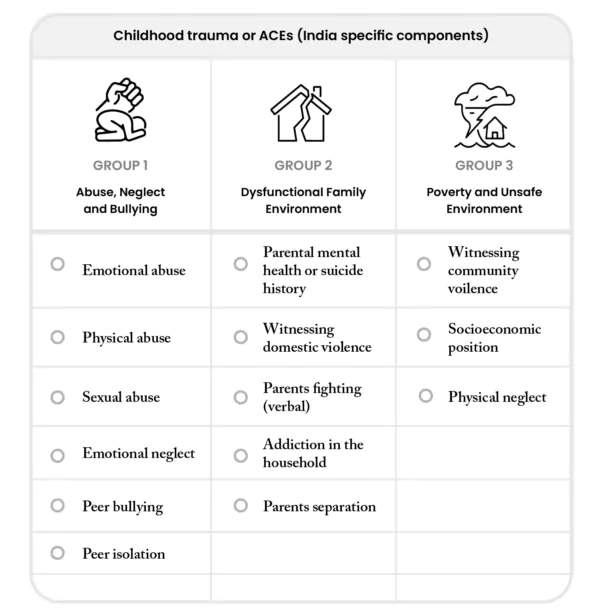
Developed from observations across thousands of ACE assessments, psychotherapy sessions, and research interactions in India, the framework extends conventional ACE measures by including 14 questions across three core categories (Figure 1):
- Abuse, Neglect and Bullying (Interpersonal trauma)
- Dysfunctional Family Environment (Household challenges)
- Poverty and Unsafe Environment
Figure 1: India Specific ACE14 questionnaire
Why it matters for adult mental health
These experiences do not disappear when childhood ends. They quietly shape how an adult relates to work, partners, parenting, conflict, and themselves. The Trivedi ACE-14 Assessment™ helps identify trauma exposure that has been hiding in plain sight — and connects it to the anxiety, depression, relationship conflict, emotional dysregulation, and complex trauma symptoms that bring people into therapy in the first place.
“In many Indian families, the wound isn’t what was done — it’s what was never named.”
Who this is for
- Therapists and researchers working with Indian clients and seeking a more contextually accurate trauma-exposure measure.
- Adults who sense their distress has roots earlier than they can articulate, and want a careful, culturally honest way to look back.
- Parents who want to understand the patterns they inherited and the ones they are passing on.
Frequently asked questions
- How is the Trivedi ACE-14™ different from the original ACE questionnaire? It retains the empirical strength of the original ACE while adding categories that reflect Indian family realities. It is designed to capture what conventional tools miss in this cultural context. The assessment also includes frequency of occurrence, which provides a unique additional perspective on the repeated nature of some of the traumatic experiences.
- Does a high ACE-14 score mean I am damaged? No. The score reflects exposure, not destiny. Many people with high scores live full, integrated lives. The assessment is intended to inform understanding and care, not to label. In fact, our recent research highlights that understanding the footprints of both positive childhood experiences (PCEs) and ACEs, along with several other assessments, is required to assess the associated risks and manifestations.
- Will this assessment cause me or the therapist to dislike my family/parents or be judgmental about their parenting? The framework is descriptive, not accusatory. Its purpose is to help you understand the environment that shaped you — including the constraints your caregivers themselves were carrying. Recovery work is about what you do now, not about assigning fault.
- Can the assessment be taken without therapy? It is best interpreted alongside a trained therapist who can help you make sense of what the results mean for your present-day life. Taking it in isolation can surface material that benefits from support.
Our Book has more details
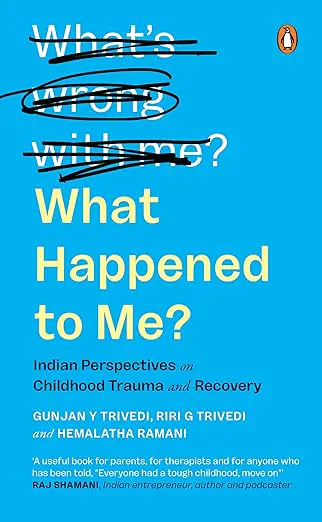
The concepts behind PsyKundali™, PsyComplexity™, trauma recovery, and the Pancha Kosha Trauma Framework™ are discussed in detail in our evidence-based book, What Happened to Me?
Contact us for consultation
PsyKundali™ assessments and interpretation sessions are available through consultation at Wellness Space, Ahmedabad.
https://wellness-space.net/contact-us-new/
References:
[1] Trivedi, G. Y., Surana, P., Pandya, N., Patel, N., Trivedi, R. G., Kathirvel, S., & Kumar, A. (2025). Psychometric properties of expanded Adverse Childhood Experiences Assessment Questionnaire at a wellness centre in India. Asian Journal of Psychiatry, 104523