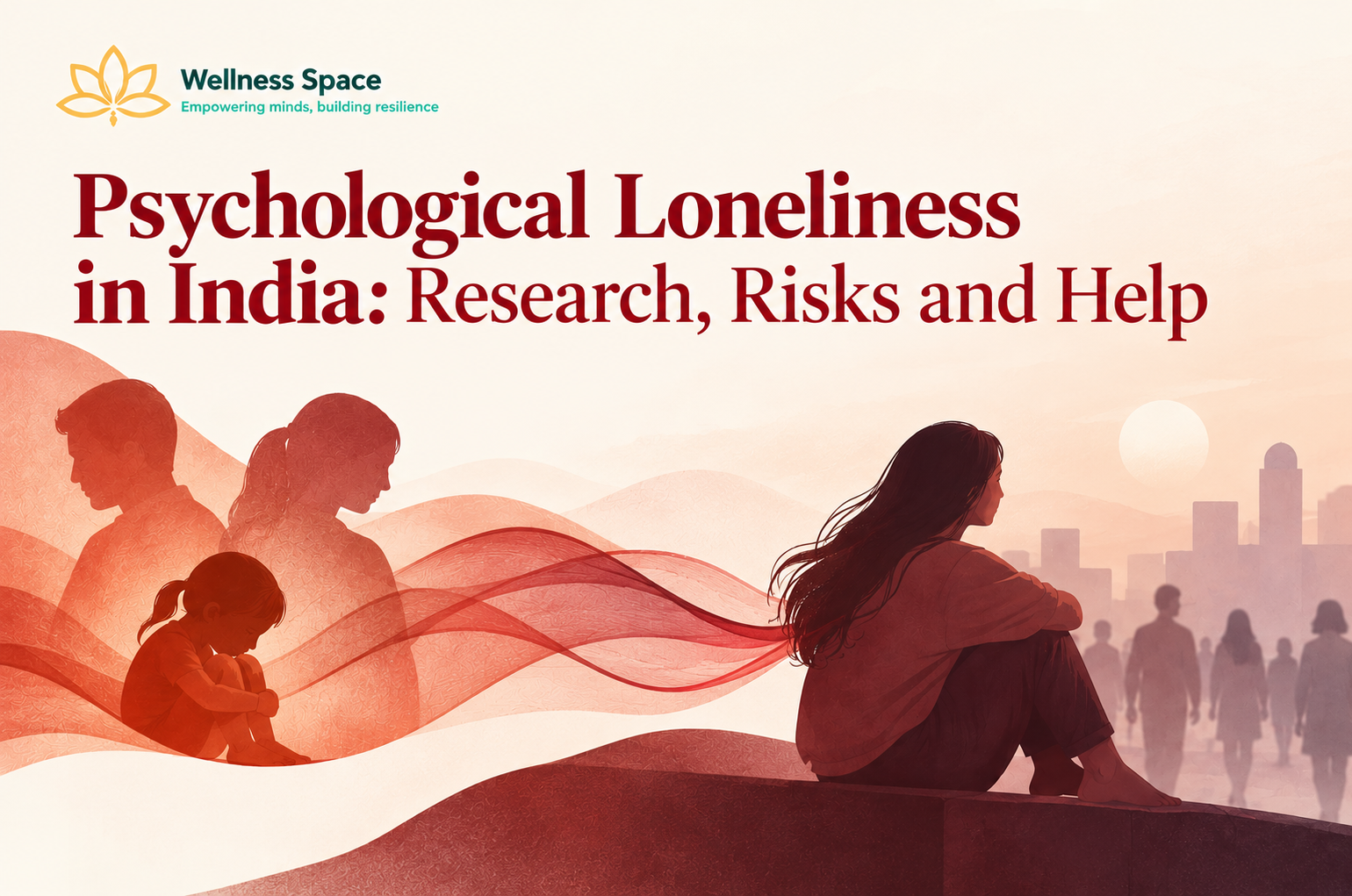
Psychological Loneliness in India: Feeling Alone Among People
Some of the loneliest people we meet are never alone. They share a home with parents, a spouse and children. They are in family WhatsApp groups and office meetings all day. And yet, when we ask who really knows them, they go quiet.
This is psychological loneliness: the ache of feeling unconnected even when people are all around you. It is not a small sadness. Worldwide, it is linked to about 100 deaths every hour [1]. It raises the risk of depression, heart disease, dementia and suicidal thoughts. And in India, where we often assume family protects us, the story is more complicated than we like to admit.
In 2023, India recorded 171,418 suicides. Suicide rarely has a single cause, but when police record the main reason behind each death, the most common category is not illness, money or exam results. It is family problems, recorded in 32% of cases [2]. Being surrounded by family is not the same as feeling safe within it.
At Wellness Space in Ahmedabad, our research keeps pointing to where that gap often begins: in childhood. This page explains what psychological loneliness is, how it is measured, what it does to mind and body, what is happening in India, what our studies with Indian adults have found, and what helps.
If you are struggling right now, please call Tele-MANAS on 14416 (or 1-800-891-4416).
Loneliness at a glance
- 1 in 6 people worldwide experience loneliness; among young people aged 13–29 it is 17–21% [1].
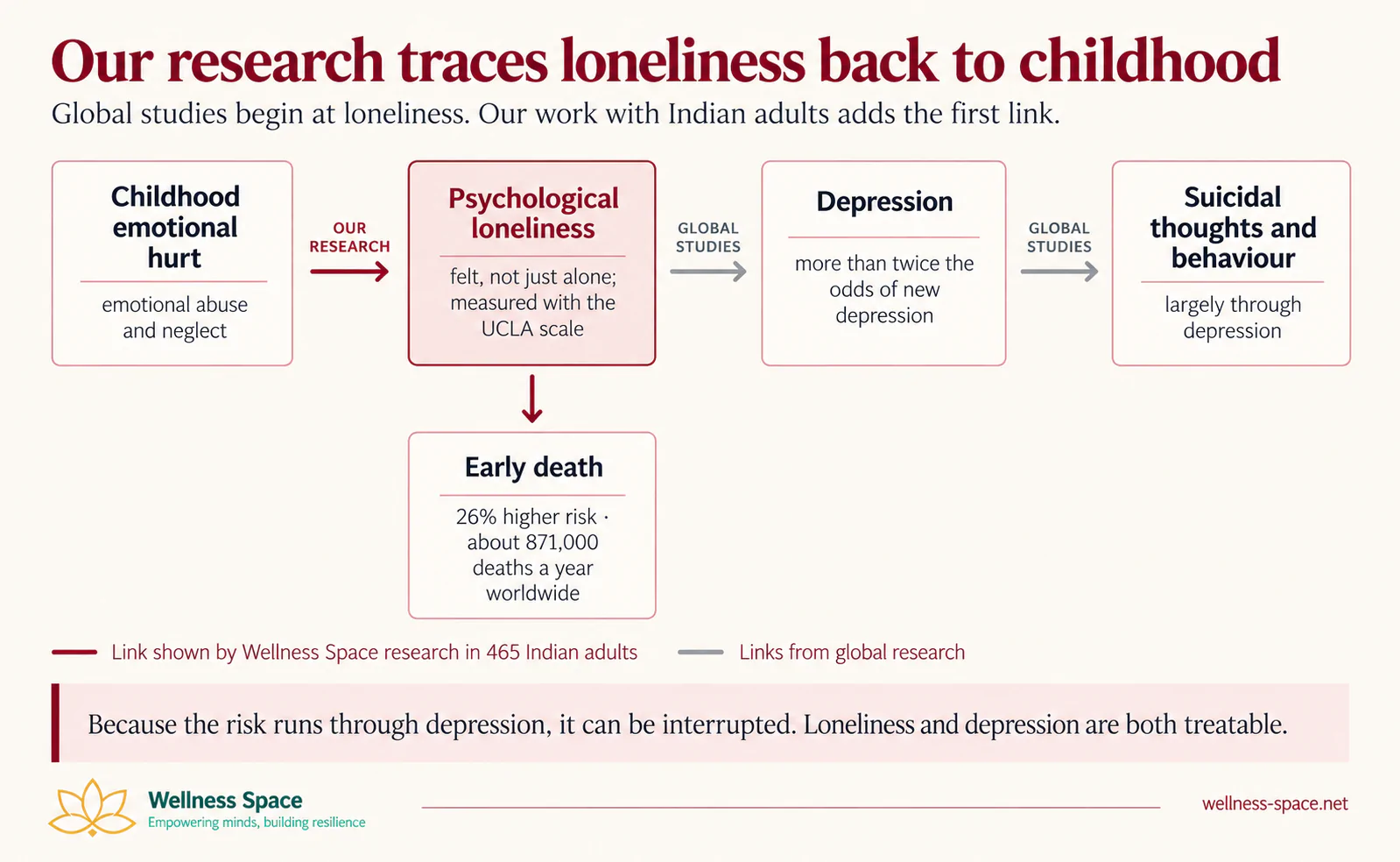
- Loneliness is linked to about 871,000 deaths a year worldwide [1] and a 26% higher risk of dying early [3].
- Lonely adults have more than twice the odds of developing depression later [4].
- Loneliness and social isolation are linked to a 29% higher risk of heart disease and a 32% higher risk of stroke [5], and a 31% higher risk of dementia [6].
- It predicts later suicidal thoughts and behaviour, largely through depression [7].
- In India, about 1 in 10 adults has a current mental health condition, and 5% of them get no treatment [8].
- In Gujarat, 4 in 10 older adults were lonely [9].
- In our own study of 465 adults who had lived through trauma, the average loneliness score was above the usual cut-off for “lonely” [10].
Being alone vs feeling alone
There are two different experiences hiding behind the word “lonely”, and they need different responses.
Physical loneliness is also called social isolation. It is objective: living alone, having few contacts, rarely seeing anyone. You could count it.
Psychological loneliness is subjective. It is the gap between the closeness you want and the closeness you actually feel. You cannot count it from the outside, because it depends on whether your relationships feel safe, warm and real to you.
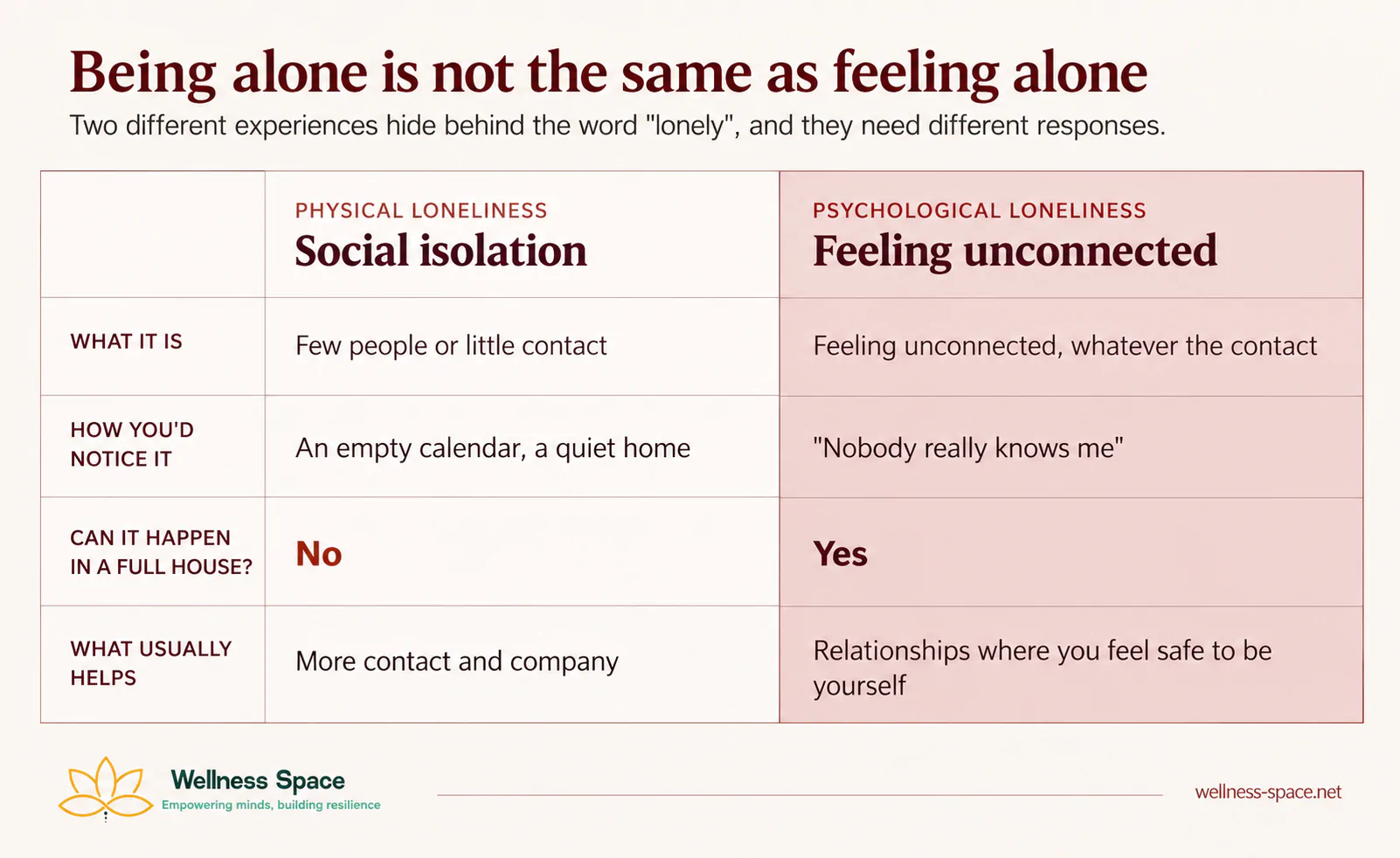
The two do not always go hand in hand. A person living alone may feel content and connected. A person in a busy joint family may feel deeply alone. This page is about the second kind, because it is the one most often missed, especially in a culture that assumes family is protection enough.
How psychological loneliness is measured
Because psychological loneliness is a feeling, researchers measure it by asking people carefully chosen questions. The most widely used tool is the UCLA Loneliness Scale. We use its short, three-question version in our work because it is quick, reliable, and used by researchers worldwide [11].
It asks how often you:
- Feel you lack companionship
- Feel left out
- Feel isolated from others
Each answer is scored 1 (hardly ever), 2 (some of the time) or 3 (often). Totals run from 3 to 9, and a score of 6 or above is commonly read as lonely.
Note: This is a screening tool, not a diagnosis. A high score is a reason to pay attention, not a label. Psychological loneliness is not a psychiatric diagnosis. It describes the subjective experience of feeling emotionally disconnected from others, even when people are physically present.
The gap in India’s data
India’s largest national survey on ageing, the Longitudinal Ageing Study in India (LASI), did not include the UCLA questions. Researchers had to rely on a single question: how often do you feel alone? Using that question, about 13.4% of adults over 60 reported feeling lonely often [12].
That tells us something, but not enough. Two recent reviews of Indian research say the same thing. A 2025 scoping review found that almost all available studies are on older adults, and that work on younger people is scarce [13]. A 2026 systematic review pooled 20 studies of older Indians and found loneliness figures ranging from under 4% to over 66%, depending on who was asked and how [14].
We know very little about working-age Indian adults — the people in their twenties, thirties and forties who make up most of the country, and most of the people who walk through our doors.
What loneliness does to mind and body
The evidence here is direct, so we will be direct too.
It shortens lives
The largest analysis on this question pooled 70 studies following 3.4 million people. People who reported loneliness had a 26% higher risk of dying early, even after accounting for their health at the start. Social isolation raised the risk by 29% and living alone by 32% [3]. The WHO puts the global toll at about 871,000 deaths a year [1].
It strains the heart and the brain
A review of 23 studies with more than 180,000 adults found that poor social relationships were linked to a 29% higher risk of coronary heart disease and a 32% higher risk of stroke [5].
The brain pays too. A 2024 analysis of 21 studies and over 600,000 people found that loneliness raised the risk of dementia by about 31%, and of Alzheimer’s disease by about 39%. The link held even after taking depression and social isolation into account [6].
It leads to depression
Loneliness is not just a symptom of depression; it often comes first. A review of 32 long-term studies, covering more than 650,000 people in 24 countries, found that lonely people had 2.33 times the odds of developing depression later. Loneliness was also linked to later anxiety, self-harm and suicidal thoughts [4].
In India, depression rarely gets treated. The last national mental health survey found that about 1 in 10 Indian adults had a current mental health condition, and 84.5% of them received no treatment [8]. When loneliness feeds depression and depression goes untreated, the cycle can run for years.
It is linked to suicidal thoughts and behaviour
This needs to be said carefully and accurately.
A review of 22 studies that followed people over time found that loneliness predicted later suicidal thoughts and suicidal behaviour, and that it did so largely through depression. The link was strongest in young people aged 16–20, in older adults, and in samples that were mostly women [7].
That review noticed something important for India. All 22 studies came from individualistic cultures, where independence is prized. The authors called for research in collectivist societies — societies like ours, built around family and community.
India needs that research. In 2023, the country recorded 171,418 suicides, a rate of 12.3 per 100,000 people. About two in three were aged 18–45. Family problems were the most common cause recorded by police (32%), followed by illness (19%)[2][15]. These figures do not tell us how many of those people were lonely. But they do show that crisis often happens inside families, not away from them.
What our research shows about childhood adversity and suicidal behaviour
Our own work adds a piece to this picture. In one of our studies, a path model showed that higher childhood adversity (ACE) scores were linked to suicidal behaviour both directly and through several routes: depression, self-harm, irrational decisions and disordered eating. Depression was linked to each of the other problems and to suicidal behaviour itself, and together these factors explained about 20% of the variation in suicidal behaviour. (Note: This model is based on cross-sectional data, and used structural equation modelling, and therefore provides an idea of the associations at the time the assessment was done)
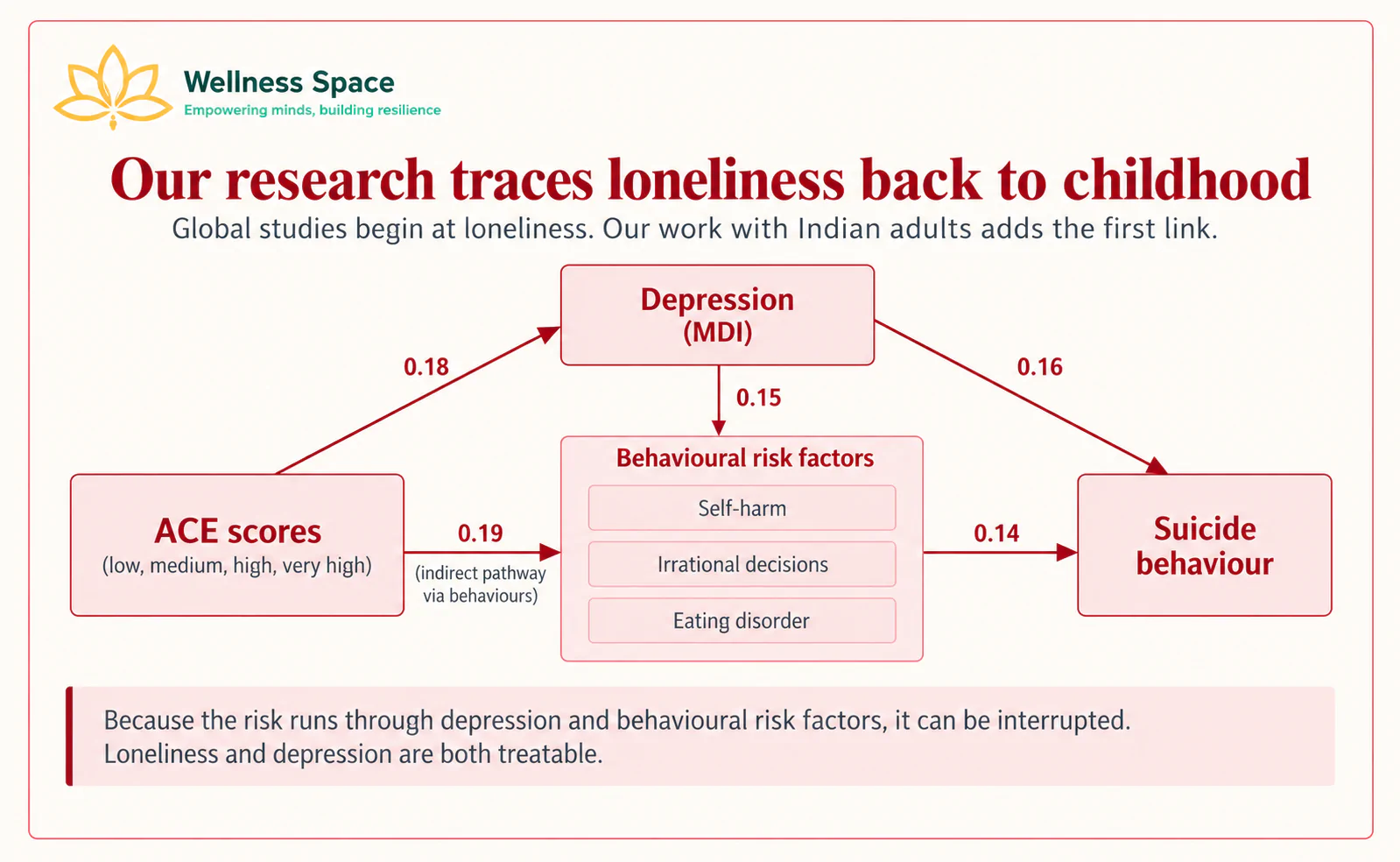
Loneliness is not in this model. But depression sits at its centre, and depression appears to be an important pathway linking loneliness with suicide risk. Childhood adversity, loneliness and depression are not separate stories; they are parts of the same one.
Two things follow, and both matter.
First, loneliness deserves to be taken seriously as a warning sign. If someone in your life has withdrawn and stayed withdrawn, that is worth a direct, caring conversation, not a wait-and-see.
Second — and this is the more important half — a risk that runs through depression can be interrupted. Depression is treatable. Loneliness is treatable. This is not a fixed path, and people who have felt alone for years do recover.
Substance use and screens: a more complicated link
It is often said that lonely people drink or use drugs more. The evidence is more nuanced.
In a Czech study of 1,293 adults from the general population, loneliness was not linked to how often people drank, smoked or used drugs. It was clearly linked to problematic internet use [16]. But among people who already had problems with alcohol or cannabis, those who were moderately or severely lonely went on to use more often over the following weeks [17].
Young people’s screen habits also deserve attention. Across many countries, teenagers’ loneliness at school rose between 2012 and 2022, and it rose more in countries where students used electronic devices more for leisure at school [18].
Childhood matters here too. In a study of 1,044 adolescents who had experienced childhood trauma, loneliness was one of the paths from that trauma to internet addiction [19].
In India, substance use problems were the most common category found in the national mental health survey [8]. For someone already struggling, loneliness can make it harder to stop. For many others, loneliness shows up on the scrolling screen, not in the bottle.
It disturbs sleep
Loneliness and poor sleep feed each other. In our study of 579 adults, higher resilience was linked to lower loneliness, and lower loneliness to better sleep. In Gujarat, lonely older adults slept about 43 minutes less a night than others [9]. Tired people have less energy for connection, and the loop tightens.
India today: a country of families, and of lonely people
India is a young country with deep family traditions. Both facts shape loneliness here.
The need is visible. Since its launch in 2022, the government’s Tele-MANAS mental health helpline has handled more than 32.8 lakh calls, through 53 cells in 36 states and union territories, in 20 languages [20]. Money worries are common too: one survey, cited in our financial well-being study, found that 82% of Indian adults face financial stress [21].
How Indian society shapes loneliness
Indian studies show that loneliness here follows the fault lines of family, gender, and migration.
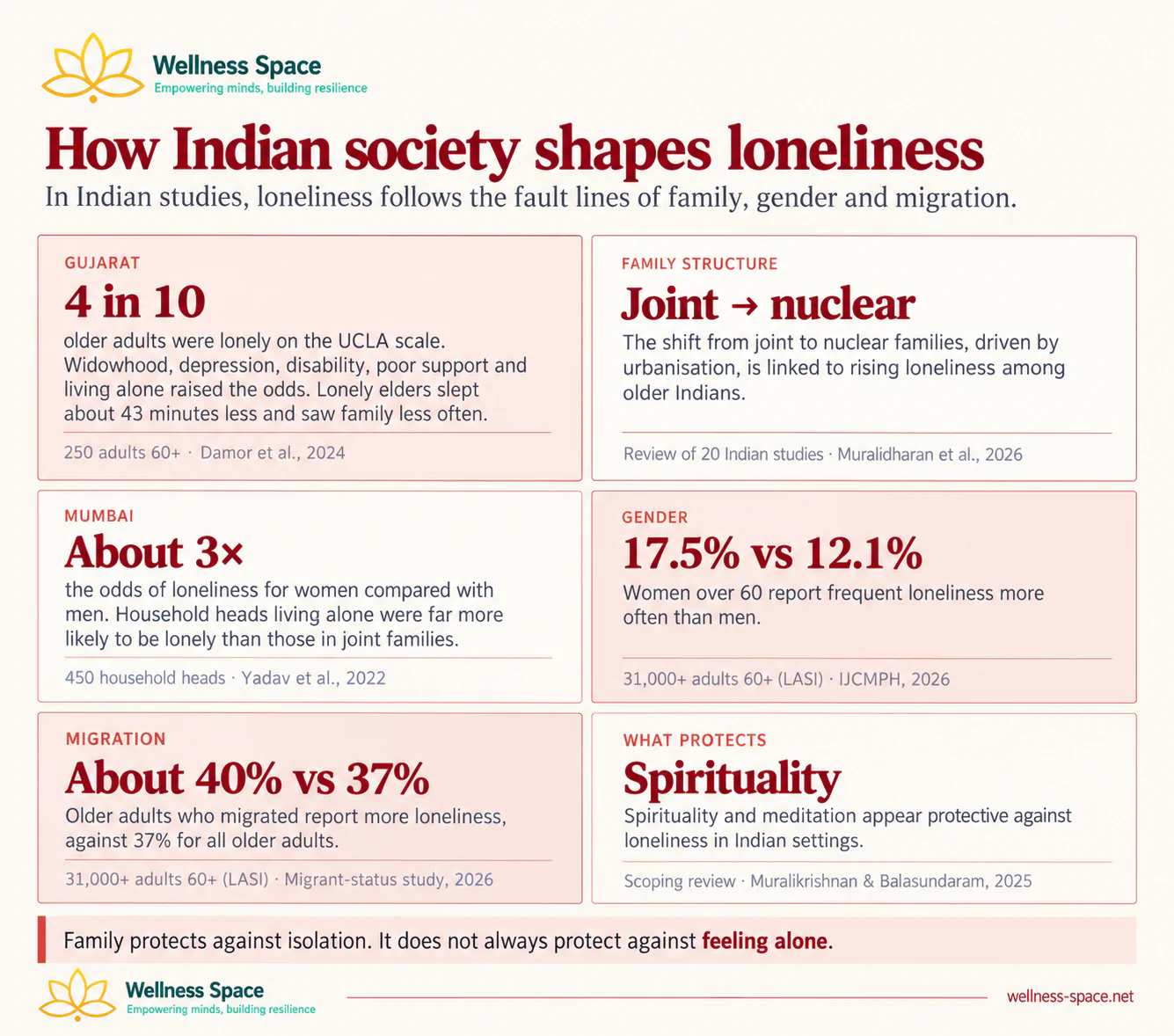
The clearest picture close to home comes from Gujarat. In a 2024 study of 250 adults over 60, living at home and in old-age homes, 4 in 10 were lonely on the UCLA scale [9]. Widowhood, depression, disability, poor social support and living alone all raised the odds. Lonely elders also stayed in touch with family less often, slept less, exercised less, and went for fewer health check-ups. Loneliness quietly changes how people look after themselves.
Family structure is a recurring theme. The 2026 review links the shift from joint to nuclear families, driven by urbanisation, to rising loneliness among older Indians [14]. In Mumbai, a study of 450 household heads found that those living alone were far more likely to be lonely than those in joint families, and that women had about three times the odds of men [22].
Gender and migration matter too. In India’s national ageing survey, women over 60 reported frequent loneliness more often than men: 17.5% against 12.1% [23]. Older adults who had migrated reported more loneliness than older adults overall [24]. On the protective side, the 2025 review found that spirituality and meditation appear to reduce loneliness in Indian settings [13].
Together, these findings point to something important. Indian society has long relied on the joint family to keep people connected, and as that structure changes, many older adults are left more alone. But the family is not a guarantee. Women report more loneliness than men, and our own research finds loneliness in adults who are rarely physically alone.
In other words, being surrounded by family protects against isolation. It does not always protect against feeling alone.
Where loneliness begins
The big studies tell us why loneliness matters. They do not explain why two people with similar lives, families, and friendships can feel so differently about their relationships.
Research from other countries has started to look at childhood. A large review found that people who were maltreated as children are more likely to be lonely across their lives [25]. A UK study of tens of thousands of adults found the same link, along with more depression and signs of social exclusion [26]. In young adults in China, loneliness was one of the routes from childhood trauma to depression [27].
But how childhood experiences turn into adult loneliness is still unclear. Until recently, we had no data on this from Indian adults.
Picture a child whose tears are met with irritation, or whose worth seems to depend on marks and good behaviour. Over time, that child may decide it is safer to keep their inner world to themselves. They may become the dependable one, the easy-going one, the one who never asks for anything. As adults, they can be surrounded by people and still feel that nobody really knows them.
That is the question our research set out to test.
→ Related: Adult loneliness and childhood trauma · Trivedi Depression Pathways™
What our research at Wellness Space found
Over the past few years, we have studied loneliness in adults who came to our Ahmedabad centre for help. Unlike most Indian research, our participants are mainly working-age adults. Four findings stand out.
1. For many, loneliness is the norm, not the exception
Between 2022 and 2025, we studied 465 adults who had lived through significant trauma. Their average age was about 31, and three in four were women. On the UCLA scale, their average score was 6.5 — above the usual cut-off for “lonely”. In other words, the typical person in this group was lonely [10].
2. Adult Loneliness is often associated with childhood emotional maltreatment
In the same study, we looked at emotional abuse and emotional neglect in childhood — for example, being shamed, ignored or dismissed when upset — and at loneliness and depression in adulthood.
What we found surprised us. Emotional abuse and neglect in childhood were not directly linked to adult depression. Instead, they were linked to loneliness, and loneliness was strongly linked to depression, in both men and women [10].
In plain terms: the path from a painful childhood to adult depression seemed to run through loneliness. If that holds, loneliness is not just a side effect. It is a point where help can make a difference.
Childhood emotional hurt was also linked to the deeper difficulties seen in complex trauma (Complex PTSD): trouble managing emotions, a harsh view of oneself, and struggles in close relationships. Loneliness added to these directly in women, and through depression in men. Together, childhood emotional hurt, loneliness and depression explained about half of the variation in these difficulties.
→ Read our study on childhood emotional maltreatment and loneliness · Our complex trauma (CPTSD) research
3. In men, loneliness shows up in money
In a separate study of 311 urban Indian adults, we asked what shapes how secure people feel about money. Income and financial knowledge mattered, as expected. But loneliness also mattered — and only in men. Lonely men felt less financially secure, even after accounting for their income and financial know-how. As far as we know, this was the first study to link loneliness with financial well-being [21].
This fits something we see in therapy. Many Indian men are taught to measure themselves by what they provide, and men are less likely to talk openly about emotional pain. Loneliness may surface in worry about money and work, rather than as a feeling they name.
So if you are worried about a man in your life, asking “Are you lonely?” may get you nowhere. Asking how he feels about work, money, or whether he feels he is doing enough may open the door.
→ Read: Are lonely men unhappy financially?
4. Resilience and support protect
In our unpublished study of 579 adults, people with higher resilience — the ability to bounce back from hard times — were less lonely and slept better. Our daily interactions with individuals who come with a history of childhood trauma also point the same way: resilience and feeling supported are often associated with lower loneliness, even among people who were emotionally hurt as children.
Both can be built. That is where therapy comes in.
→ Our study on parenting, resilience and trauma · All our childhood trauma research in India
A note on what these studies can and cannot say. They took a snapshot at one point in time, so they show links, not proof of cause. The people in them were mostly urban, English-speaking adults who came to us for help, not a sample of all Indians. We are working on larger, longer studies.
How we teach it
Because loneliness so often hides behind other complaints, we train psychologists and counsellors to screen for childhood emotional hurt, loneliness and depression together, rather than one at a time. It is part of our evidence-based psychotherapy training and our inner child therapy training.
In our book
Chapter 9 of What Happened to Me? vs What’s Wrong with Me? (Ebury Press, Penguin Random House India) looks at loneliness as a silent driver of adult mental health struggles, with tools for self-discovery [28]. Its section “Loneliness, the Silent Epidemic” makes the same case as this page, for a wider audience.
Loneliness as the bridge. The book puts it simply: “loneliness is the bridge between childhood trauma … and adult mental health issues” [28, p. 262]. It names emotional neglect, emotional abuse and physical abuse as the experiences most often behind that bridge, and asks therapists to trace these links and work with the emotional imprint that childhood left behind.
The Trivedi Depression Pathways™. The book’s model of recurring depression (Figure 46) maps how childhood trauma, perceived social support, loneliness and insomnia connect on the way to adult depression [28]. Read more about the model on our Trivedi Depression Pathways™ page.
Why loneliness can make people pull away. Drawing on psychologist John Cacioppo’s evolutionary theory of loneliness, the book explains that feeling lonely signals us to reach out when support is missing. But for someone hurt when young, the same signal can lead to self-protective withdrawal. That withdrawal keeps them lonely and makes real connection harder, sometimes showing up as social anxiety.
Support builds resilience. Feeling socially supported strengthens resilience and softens the long-term effect of childhood trauma on loneliness and mental health. Understanding how the two work together can help people reconnect and prevent loneliness in adulthood.
Tracking change in therapy. The book shows how our PsyKundali™ dashboard tracks resilience, social support and loneliness during therapy. In one example, a client’s resilience and sense of support rose, and loneliness fell, though not yet to the target: a UCLA loneliness score below 5 [28, p. 262].
What helps
Why “just go out more” often isn’t enough
The usual advice for loneliness is to meet people, join a group or spend less time on your phone. That is good advice for someone who is simply short of company.
But if closeness has felt unpredictable or unsafe since childhood, more company may not touch the feeling. You can sit in a crowded room and still keep everyone at arm’s length, because somewhere you learnt that showing your real self was risky. More contact with the same guard up often leaves people feeling lonelier, not less.
What does help
- Relationships where you no longer have to hide. Recovery usually begins with one or two connections — a friend, a partner, a therapist — where you can be honest about what you feel and still be accepted.
- Therapy that works on the root, not just the symptom. Approaches that address old beliefs about yourself and others (“people leave”, “I’m too much”, “I must manage alone”) can help address the underlying patterns rather than focusing only on increasing social contact. Our inner child therapy work focuses on exactly these early patterns.
- Treating depression when it is there. Since loneliness so often works through depression, treating one helps the other.
- Watching the coping habits. If drinking, smoking, or endless scrolling has become how you get through the evening, that is worth noticing — and worth talking about.
- Building resilience and support deliberately. Both are associated with lower loneliness in our research, and both can be strengthened with help.
When to seek help
Consider talking to a professional if the feeling of being alone has lasted for months, if it is affecting your sleep, work or relationships, if you are relying more on alcohol, drugs or screens to cope, or if you find yourself withdrawing from people who care about you.
Prevention starts in childhood.
If loneliness in adults often begins with childhood emotional experiences, then prevention begins at home and in school. Children who feel emotionally safe, accepted and helped through hard feelings are more likely to grow into adults who can trust and connect.
This is not about blaming parents. Most parents give what they themselves received. The most useful thing a parent can do is often to work on their own emotional history, so they can stay steady when their child is struggling.
For India, with one of the world’s youngest populations, this is a mental health priority and a long-term investment in the country’s future. Instead of only asking “Why am I lonely?”, it may help to look back gently at what you learnt growing up about asking for comfort—and whether that lesson still fits the life you have now.
Support is available
If you are struggling, please call Tele-MANAS on 14416 (or 1-800-891-4416), free and available 24 hours in many Indian languages. In an emergency, call 112. You do not have to wait until things are unbearable to reach out.
If you would like to work with us, book a session at Wellness Space.
Frequently asked questions
What is psychological loneliness?
It is the feeling of being unconnected, even when you have people around you. It comes from the gap between the closeness you want and the closeness you feel, not from how many people you see.
Can you be lonely in a joint family or a marriage?
Yes. Psychological loneliness depends on whether you feel safe and truly known in your relationships, not on how many people share your home. Many of the adults we see live with family and still feel deeply alone.
How is loneliness measured?
Most often with the UCLA Loneliness Scale. Its short version asks how often you lack companionship, feel left out and feel isolated. Scores run from 3 to 9, and 6 or above is commonly read as lonely. It is a screening tool, not a diagnosis.
Is loneliness linked to depression and suicide?
Yes. Loneliness predicts later depression, and it is linked to suicidal thoughts and behaviour, largely through depression. Because depression is treatable, this risk can be reduced. If you are having thoughts of harming yourself, call Tele-MANAS on 14416.
Does loneliness affect physical health?
Yes. It is linked to a higher risk of early death, heart disease, stroke and dementia, and to poorer sleep.
Do lonely people drink or use drugs more?
Not always. In the general population, the link is weak. But for people who already struggle with alcohol or cannabis, loneliness can lead to more frequent use. Loneliness is more consistently linked to problematic internet use.
Does childhood trauma cause loneliness in adults?
Research, including ours with Indian adults, shows a clear link between emotional abuse or neglect in childhood and loneliness in adulthood. Because these studies are snapshots in time, they show a link, not proof of cause.
Can therapy help with loneliness?
Yes. Therapy that works on the beliefs and patterns formed in childhood, alongside treatment for depression where needed, often helps more than advice to be more social.
Our research on loneliness
- Trivedi, G., Pandya, N., Thakore, P., Ramani, H., & Patel, N. (2026). A structural equation modelling approach to understand the associations between childhood emotional maltreatment, loneliness, depression and disturbances in self-organization at a wellness centre in India. International Journal on Child Maltreatment, 9(1), 107–128. https://doi.org/10.1007/s42448-025-00249-9
- Trivedi, G. Y., Pabari, R., Trivedi, A., & Baxi, C. (2026). Are lonely men unhappy financially? Gender differences in factors associated with financial well-being. Journal of Financial Counseling and Planning. https://doi.org/10.1891/JFCP-2024-0096
- Trivedi, G. Y., Trivedi, R. G., & Ramani, H. (2026). What happened to me? vs What’s wrong with me?: Indian perspectives on childhood trauma and recovery. Ebury Press. Chapter 9 covers loneliness.
- See all our childhood trauma research →
Read the short version on our Substack: The loneliness that doesn’t look like loneliness
Read more on Adult loneliness and the role of Childhood trauma
References
- World Health Organization (2025). From Loneliness to Social Connection: Charting a Path to Healthier Societies. Commission on Social Connection. https://www.who.int/groups/commission-on-social-connection
- National Crime Records Bureau (2025). Accidental Deaths & Suicides in India 2023. Ministry of Home Affairs, Government of India. https://www.ncrb.gov.in/uploads/files/1ADSIPublication-2023.pdf
- Holt-Lunstad, J., Smith, T. B., Baker, M., Harris, T., & Stephenson, D. (2015). Loneliness and social isolation as risk factors for mortality: A meta-analytic review. Perspectives on Psychological Science, 10(2), 227–237. https://doi.org/10.1177/1745691614568352
- Mann, F., Wang, J., Pearce, E., et al. (2022). Loneliness and the onset of new mental health problems in the general population. Social Psychiatry and Psychiatric Epidemiology, 57(11), 2161–2178. https://doi.org/10.1007/s00127-022-02261-7
- Valtorta, N. K., Kanaan, M., Gilbody, S., Ronzi, S., & Hanratty, B. (2016). Loneliness and social isolation as risk factors for coronary heart disease and stroke: Systematic review and meta-analysis of longitudinal observational studies. Heart, 102(13), 1009–1016. https://doi.org/10.1136/heartjnl-2015-308790
- Luchetti, M., Aschwanden, D., Sesker, A. A., et al. (2024). A meta-analysis of loneliness and risk of dementia using longitudinal data from >600,000 individuals. Nature Mental Health. https://doi.org/10.1038/s44220-024-00328-9
- McClelland, H., Evans, J. J., Nowland, R., Ferguson, E., & O’Connor, R. C. (2020). Loneliness as a predictor of suicidal ideation and behaviour: A systematic review and meta-analysis of prospective studies. Journal of Affective Disorders, 274, 880–896. https://doi.org/10.1016/j.jad.2020.05.004
- Gautham, M. S., Gururaj, G., Varghese, M., et al. (2020). The National Mental Health Survey of India (2016): Prevalence, socio-demographic correlates and treatment gap of mental morbidity. International Journal of Social Psychiatry, 66(4), 361–372. https://doi.org/10.1177/0020764020907941
- Damor, N., Yogesh, M., Makwana, N., Trivedi, N., & Kagathara, J. (2024). Prevalence and predictors of loneliness and its association with health-seeking behaviors among the elderly population, Gujarat: A community-based cross-sectional study. Journal of Family Medicine and Primary Care, 13(7), 2719–2723. https://doi.org/10.4103/jfmpc.jfmpc_2012_23
- Trivedi, G., Pandya, N., Thakore, P., Ramani, H., & Patel, N. (2026). A structural equation modelling approach to understand the associations between childhood emotional maltreatment, loneliness, depression and disturbances in self-organization at a wellness centre in India. International Journal on Child Maltreatment, 9(1), 107–128. https://doi.org/10.1007/s42448-025-00249-9
- Hughes, M. E., Waite, L. J., Hawkley, L. C., & Cacioppo, J. T. (2004). A short scale for measuring loneliness in large surveys. Research on Aging, 26(6), 655–672. https://doi.org/10.1177/0164027504268574
- Srivastava, P., & Srivastava, M. (2023). Prevalence and correlates of loneliness in the later life — insights from LASI Wave-1. Indian Journal of Psychiatry, 65(9), 914–921. https://doi.org/10.4103/indianjpsychiatry.indianjpsychiatry_594_22
- Muralikrishnan, N., & Balasundaram, S. (2025). Epidemiology of loneliness and social isolation, an emerging public health concern in India: A scoping review. Discover Mental Health. https://doi.org/10.1007/s44192-025-00132-6
- Muralidharan, N., Thiagesan, R., & Gopichandran, V. (2026). Prevalence and determinants of social isolation and loneliness among the elderly in India: A systematic review. Indian Journal of Medical Research. https://pmc.ncbi.nlm.nih.gov/articles/PMC13363178/
- Centre for Mental Health Law & Policy (2025). Takeaways from the NCRB data on suicide for 2023. https://cmhlp.org/imho/blog/takeaways-from-the-ncrb-data-on-suicide-for-2023-what-has-changed/
- Meckovsky, F., Furstova, J., Kosarkova, A., Meier, Z., Tavel, P., & Malinakova, K. (2023). Loneliness is associated with problematic internet use but not with the frequency of substance use: A Czech cross-sectional study. International Journal of Public Health, 68, 1606537. https://doi.org/10.3389/ijph.2023.1606537
- Gutkind, S., Gorfinkel, L. R., & Hasin, D. S. (2021). Prospective effects of loneliness on frequency of alcohol and marijuana use. Addictive Behaviors. https://vivo.weill.cornell.edu/display/pubid34543868
- Twenge, J. M. (2026). International declines in academic performance and increases in loneliness are linked to electronic devices. Journal of Adolescence, 98, 250–261. https://doi.org/10.1002/jad.70058
- Dong, W.-L., Li, Y.-Y., Zhang, Y.-M., Peng, Q.-W., Lu, G.-L., & Chen, C.-R. (2023). Influence of childhood trauma on adolescent internet addiction: The mediating roles of loneliness and negative coping styles. World Journal of Psychiatry, 13(12), 1133–1144. https://doi.org/10.5498/wjp.v13.i12.1133
- Press Information Bureau (2026, 6 February). Update on Tele-MANAS. Ministry of Health and Family Welfare. https://www.pib.gov.in/PressReleasePage.aspx?PRID=2224522
- Trivedi, G. Y., Pabari, R., Trivedi, A., & Baxi, C. (2026). Are lonely men unhappy financially? Gender differences in factors associated with financial well-being. Journal of Financial Counseling and Planning. https://doi.org/10.1891/JFCP-2024-0096
- Yadav, V., Chauhan, S., & Patel, R. (2022). What causes loneliness among household heads: A study based in primary setting in Mumbai, India. BMC Public Health, 22(1), 730. https://doi.org/10.1186/s12889-022-13108-w
- , S. (2026). Loneliness in later life: gender-based evidence from longitudinal ageing study in India. International Journal Of Community Medicine And Public Health, 13(3), 1426–1432. https://www.ijcmph.com/index.php/ijcmph/article/view/15298
- Muhammad T, Pai M, Rishad M, Murmu A, Afsal K, Ali WK. Associations between migrant status, social isolation, and loneliness among older adults in India. BMC Geriatr. 2026 Mar 16;26(1):568. doi: 10.1186/s12877-026-07316-x. PMID: 41840539; PMCID: PMC13104440.
- De Heer, C., Bi, S., Finkenauer, C., Alink, L., & Maes, M. (2024). The association between child maltreatment and loneliness across the lifespan: A systematic review and multilevel meta-analysis. Child Maltreatment, 29(2), 388–404. https://doi.org/10.1177/10775595221103420
- Allen, S. F., Gilbody, S., Atkin, K., & Van Der Feltz-Cornelis, C. M. (2023). The associations among childhood trauma, loneliness, mental health symptoms, and indicators of social exclusion in adulthood: A UK Biobank study. Brain and Behavior, 13(4), e2959. https://doi.org/10.1002/brb3.2959
- Fan, L., Chen, Y., Zhu, M., Mao, Z., & Li, N. (2023). Correlation between childhood trauma experience and depressive symptoms among young adults: The potential mediating role of loneliness. Child Abuse & Neglect, 144, 106358. https://doi.org/10.1016/j.chiabu.2023.106358
- Trivedi, G. Y., Trivedi, R. G., & Ramani, H. (2026). What happened to me? vs What’s wrong with me?: Indian perspectives on childhood trauma and recovery. Ebury Press.