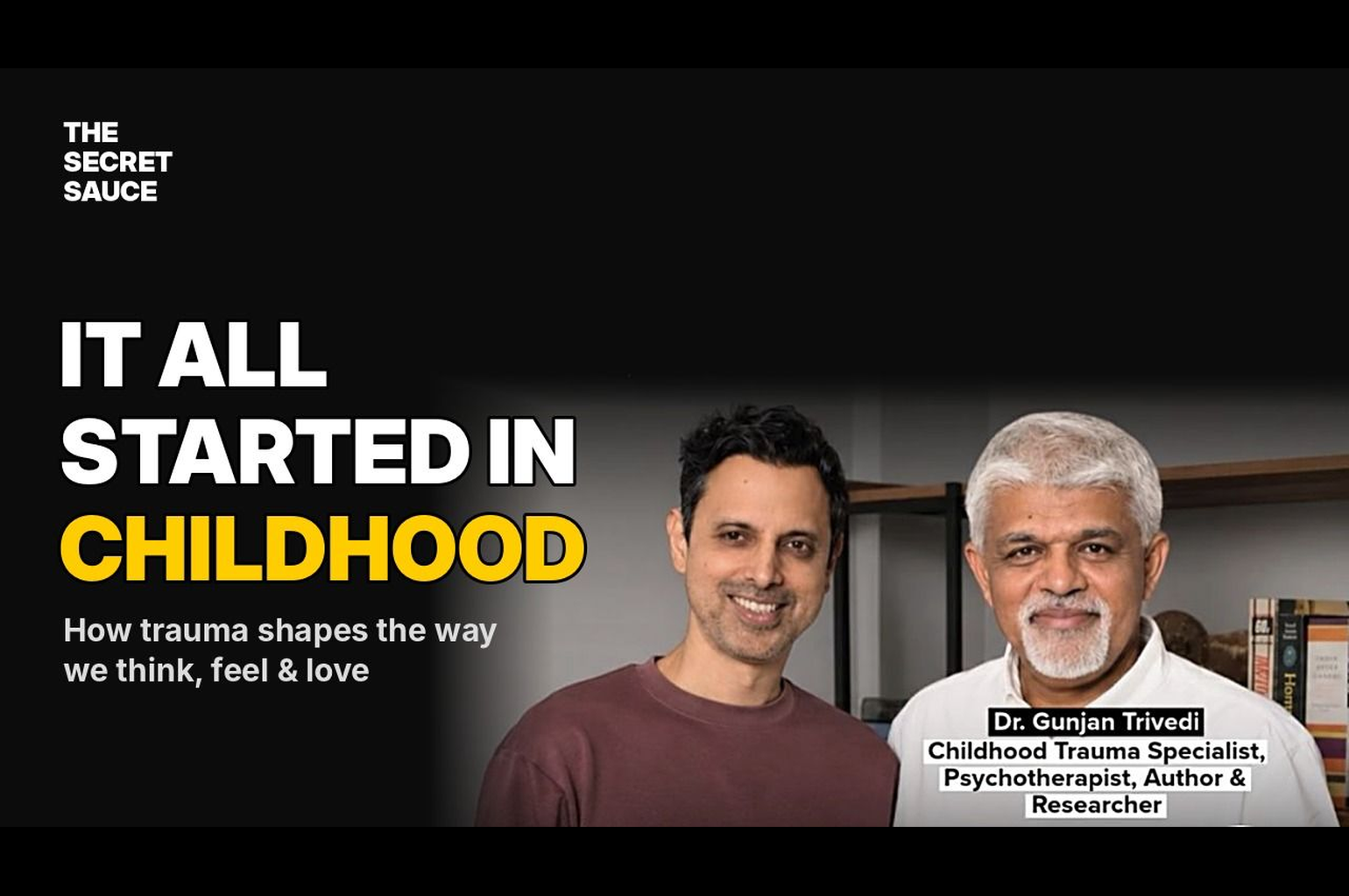
Why You Can’t Stop People-Pleasing (And How To Fix It)
In this episode: why success doesn’t repair self-worth · what actually counts as childhood trauma · approval, criticism and shame · people pleasing and the fawn response · anger and relationships · overworking and addiction as escape · raising resilient children · HRV and Bhramari
Why successful people still feel inadequate
Achievement and self-worth are built in different places. Achievement is built at school, at work, in the market. Self-worth is mostly built much earlier, in whether a child felt valued before they had done anything to earn it.
When worth was conditional — praised for marks, ignored otherwise — the adult often keeps running the same equation: I am acceptable when I perform. Success then works like a painkiller rather than a cure. There is relief, a short stretch of satisfaction, and then the pressure resets. The bar moves, because the bar was never the real problem.
This is why “but you have everything” is so unhelpful to say to someone in this loop. They know. That’s what makes it confusing.
What counts as childhood trauma — and what it does later
What is childhood trauma? (06:13) · Effects on adult mental health (12:05)
Most people picture abuse when they hear the word trauma. The research picture is wider. Persistent criticism, humiliation, inconsistent caregiving, a parent who was physically present but emotionally unavailable, and chronic pressure to perform all register in a developing child. Sometimes the problem isn’t what happened, but what kept not happening: being listened to, being reassured, having feelings taken seriously.
How much it matters depends on age, how long it went on, temperament, and — crucially — whether there was one supportive adult. In adulthood it can look like harsh self-criticism, expecting rejection, difficulty naming emotions, anxiety, shame or withdrawal. Adversity raises risk; it does not sentence anyone to anything.
Across more than 3,000 ACE assessments at Wellness Space, this quieter kind of adversity comes up far more often than the dramatic kind.
→ Childhood Trauma, ACEs and PCEs in India: What the Research Shows → Take the free ACE quiz
Lonely in a full room: loneliness and the need for approval
Loneliness (18:38) · Approval and validation (21:37)
Loneliness is not the same as being alone. It is the felt absence of being known, and plenty of people with busy social lives carry it. If reaching out as a child was repeatedly met with dismissal, the adult learns to keep needs hidden — and then wonders why closeness feels unavailable.
The same history often shows up as hunger for approval. Wanting validation is human. The trouble starts when other people’s approval becomes the main source of worth: constant reassurance-seeking, difficulty deciding alone, opinions that shift to keep the peace, real distress at simple disagreement. The healthier version is valuing someone’s view without letting it decide your value.
→ Psychological loneliness in India
Fear of criticism, and the difference between guilt and toxic shame
Fear of failure and criticism (26:27) · Toxic shame and negative thinking (1:00:54)
For some people, a small piece of feedback lands like a verdict. A minor correction at work sets off hours of self-doubt, or a project gets avoided entirely rather than risk getting it wrong. The present comment is being read through an old lens.
The distinction that helps most is between guilt and shame. Guilt says I did something wrong — it points at a behaviour, and behaviours can be corrected. Toxic shame says there is something wrong with me — it points at the whole self, and there is nothing to correct, only something to hide. Beliefs like “I am not good enough” or “I must never disappoint anyone” then work as automatic filters on everything that happens.
Separating behaviour from identity — I made a mistake, not I am a mistake — and practising self-compassion in place of reflexive self-attack are where change usually starts.
→ Narcissism and childhood trauma
People pleasing and childhood trauma: why saying no feels dangerous
People pleasing is rarely just politeness. It’s often a strategy — learned early — for staying accepted and keeping tension down. It looks like agreeing when you don’t, feeling responsible for other people’s moods, avoiding difficult conversations, and feeling guilty for having boundaries at all.
When a child learns that a parent’s anger or withdrawal can be prevented by being good, quiet or useful, that strategy works. The adult keeps using it long after the situation that required it has gone. This is the link between people pleasing and childhood trauma: not a personality flaw, but an adaptation that outlived its purpose.
There are four common ways people respond to a threat:
- Fight — confronting or resisting it
- Flight — escaping or avoiding it
- Freeze — going still, numb or unable to respond
- Fawn — appeasing and accommodating to stay safe
Fight, flight and freeze are well-established stress responses. “Fawn” is a newer, more popular term for the appeasing pattern. It’s a useful way to describe what people pleasing feels like from the inside, though it is less established as a separate physiological state.
Anger, fear and the partners we choose
Our first relationships teach us what to expect from closeness: whether affection is reliable, whether anger is safe, whether needing someone leads to comfort or to rejection. Inconsistent warmth, emotional unavailability, constant criticism or control can all shape what feels familiar in adult relationships — and familiar can be mistaken for right.
Attachment patterns are tendencies, not labels, and nobody is destined to repeat their parents’ marriage. But noticing which reactions are about the person in front of you, and which are about someone from long ago, changes a great deal.
Overthinking, overworking and other ways of escaping
Overthinking and overworking (1:07:52) · Addiction (1:11:23)
Staying busy is one of the most socially rewarded ways of not feeling. Overworking and overthinking can keep loneliness, inadequacy or distress just out of reach. Because the relief is real and immediate, the behaviour gets reinforced, even when the long-term cost is burnout, strained relationships or poor health.
Substances and compulsive behaviours can serve the same function: managing anxiety, pain or emptiness. Childhood adversity is one vulnerability among several — biology, environment and social context matter too — but it is one that therapy can actually work with.
How healing starts
The first step is noticing your triggers — the situations that set off anger, fear, shame or a sense of rejection out of proportion to what happened. Then you separate the event from the meaning you attach to it. A delayed reply is a delayed reply. Feeling it as abandonment is the old meaning, arriving on time.
Insight helps, but it rarely heals on its own. Recovery usually also needs emotional skills, supportive relationships, changes in environment, and enough repeated experiences of safety for the nervous system to update. Therapy is where that work is done deliberately.
→ Inner Child Therapy → See how therapy works at Wellness Space
Raising emotionally resilient children
Children need more than good schools and material comfort. They need a parent who is emotionally available, caregiving they can predict, permission to feel what they feel, clear boundaries, support when they fail, and repeated proof that mistakes don’t make them less loved.
Parents don’t need to be perfect. What protects children most isn’t getting it right every time — it’s repair: noticing when you got it wrong, owning it, and reconnecting. That is also how the patterns described above stop passing from one generation to the next.
→ The Biggest Parenting Mistakes — Dr Riri Trivedi on The Secret Sauce → This Book Won’t Teach You Parenting
The body’s side of the story: five layers, HRV and Bhramari
The conversation closes by moving from the mind to the body. Gunjan describes a five-layer view of the person — drawn from the Pancha Kosha model of Indian thought, spanning the physical body, breath and vital energy, mind and emotion, discernment, and deep contentment. It is a philosophical framework rather than an anatomical one, but it’s a useful reminder that trauma is held in more than thoughts.
Heart rate variability (HRV) — the natural variation in time between heartbeats — gives one measurable window into that. It reflects how flexibly the autonomic nervous system responds and recovers. HRV is shaped by sleep, fitness, health and much else, so it can’t diagnose trauma, but it can show how regulated the body is.
Gunjan’s own research has tested simple Bhramari — gentle humming on a long exhale — as a regulation practice. In a Holter-monitored study at Wellness Space, humming produced the lowest stress index of four everyday activities, lower than physical activity, emotional stress and sleep. A second study, with 118 participants, looked at which breath lengths produce the strongest HRV response. Breathwork supports psychological work; it does not replace it.
→ Humming (Simple Bhramari) as a Stress Buster — Cureus, 2023 → Effect of various lengths of respiration on HRV during simple Bhramari — International Journal of Yoga, 2023 → Bhramari Pranayama: a simple lifestyle intervention — J Ayurveda Integr Med
Ten things worth taking away
- Success doesn’t automatically build self-worth.
- Emotional neglect deserves the same attention as more visible adversity.
- People pleasing, perfectionism and overworking are often coping strategies, not personality.
- How you react to criticism is shaped by what criticism meant when you were young.
- Loneliness is about emotional disconnection, not headcount.
- Guilt is about what you did; toxic shame is about who you think you are.
- Childhood shapes relationships but doesn’t decide them.
- Noticing the pattern is the first step, not the last.
- Resilience is built through relationships and repeated experiences of safety.
- Children raised with emotional security are less likely to carry these patterns forward.
From the conversation to the book
Many of the ideas in this episode — emotional neglect, shame, the Pancha Kosha lens, and breath-based regulation — are developed in What Happened to Me? vs What’s Wrong with Me?, co-authored by Gunjan Y Trivedi, Riri G Trivedi and Hemalatha Ramani (Penguin), drawing on more than 3,000 childhood trauma assessments and 14 peer-reviewed studies at Wellness Space.
Frequently Asked Questions
Why do successful people still feel inadequate? Because achievement and self-worth are built in different places. If worth felt conditional on performance in childhood, adult success brings short-term relief rather than lasting security, and the sense of “not enough” returns once the moment passes.
Is people pleasing a trauma response? It can be. People pleasing often begins as a way to stay accepted or avoid conflict in a tense or unpredictable home. Temperament, culture and social learning play a part too, so it isn’t always trauma — but it is often an adaptation worth understanding.
What is the difference between guilt and toxic shame? Guilt is about a behaviour: “I did something wrong,” which can be repaired. Toxic shame is about the self: “There is something wrong with me.” Shame tends to lead to hiding and self-attack rather than correction.
What is the fawn response? Fawning means appeasing or over-accommodating others to stay safe, alongside the better-known fight, flight and freeze. It is a useful way to describe people pleasing, though it is less established as a separate physiological response.
Can Bhramari breathing help with stress? Research by Dr Gunjan Trivedi and colleagues found that simple Bhramari (humming) produced a lower stress index on heart rate variability measures than physical activity, emotional stress or sleep. It is a helpful regulation tool alongside therapy, not a replacement for it.
Author
Dr Gunjan Y Trivedi
Co-founder of Wellness Space and the Society for Energy and Emotions, Ahmedabad. [FILL qualifications] He is co-author of What Happened to Me? vs What’s Wrong with Me? (Penguin) and has published peer-reviewed research on adverse childhood experiences, heart rate variability and Bhramari pranayama.
If this episode sounded like you
Recognising yourself in a conversation like this is often the first time a lifelong pattern gets a name. The people pleasing, the fear of criticism, the feeling that nothing you achieve is quite enough — these are learned, which means they can be unlearned.
At Wellness Space, therapy starts with understanding what happened, not asking what’s wrong with you. Our approach draws on more than 3,000 childhood trauma assessments, 14 peer-reviewed studies, and work on both the mind and the body, from inner child therapy to breath-based regulation.
Book a consultation
Not ready yet? Start here:
- Take the free ACE quiz — five minutes, and you’ll understand your own history a little better
- See how therapy works — what to expect, from the first session onward
- Read What Happened to Me? — the book behind this conversation