Publication – Inner Child Therapy

Inner Child Therapy Research: Published Evidence from Wellness Space, India Recent publications - Inner Child Therapy's effectiveness (article 1) and five case studies (article 2) Wellness Space is one of the few psychotherapy practices in India with peer-reviewed, published evidence on the effectiveness of inner child therapy. Our research — published in the International Journal of Regression Therapy and featured in India Today — shows measurable reductions in anxiety and depression, and improvements in sleep quality and overall well-being, in adults who completed inner child therapy at our centre in Ahmedabad. What the research shows: Significant reduction in anxiety and

Publication – Inner Child Therapy2026-05-24T11:48:54+05:30

Call for action – what can mental health practitioners do to understand and manage the risk of suicide behaviour?

Call for action - what can mental health practitioners do to understand and manage the risk of suicide behaviour? By Gunjan Y Trivedi, PhD (Co-founder, Society for Energy & Emotions, Wellness Space, [email protected]) Note: This article was published in the magazine "Just let go" - by Clover Leave Academy (2024) Introduction: India, 18% of the world population, accounts for 28% of the global suicide numbers. Evidence indicates that 90% of the individuals who attempt suicide have a history of mental health issues.  Unfortunately, with >250 million young adolescents, suicide is the primary cause of death among young Indians (Age 15-39).

Call for action – what can mental health practitioners do to understand and manage the risk of suicide behaviour?2026-05-01T16:36:19+05:30

Podcast – How To Deal With Childhood Trauma, Toxic Parents & Toxic Partner – Riri Trivedi

How To Deal With Childhood Trauma, Toxic Parents & Toxic Partner - Riri Trivedi |FO237 Raj Shamani Watch the complete podcast here: https://www.youtube.com/watch?v=NznN6df13FU&t=1177s Recently, Riri G Trivedi joined this podcast and the summary (Written by Raj Shamani) is reproduced below. "One of the biggest contributors to suicide is emotional neglect and emotional abuse," said Riri G Trivedi on our podcast. She is a PhD scholar in childhood trauma & mental health, co-founder of Wellness Space and an Inner child therapy trainer and Parenting coach. This episode felt like a deep dive into understanding the impact of our childhood on our

Podcast – How To Deal With Childhood Trauma, Toxic Parents & Toxic Partner – Riri Trivedi2026-05-01T16:22:17+05:30

Childhood trauma research in India at Wellness Space (Update: Jun ’26)

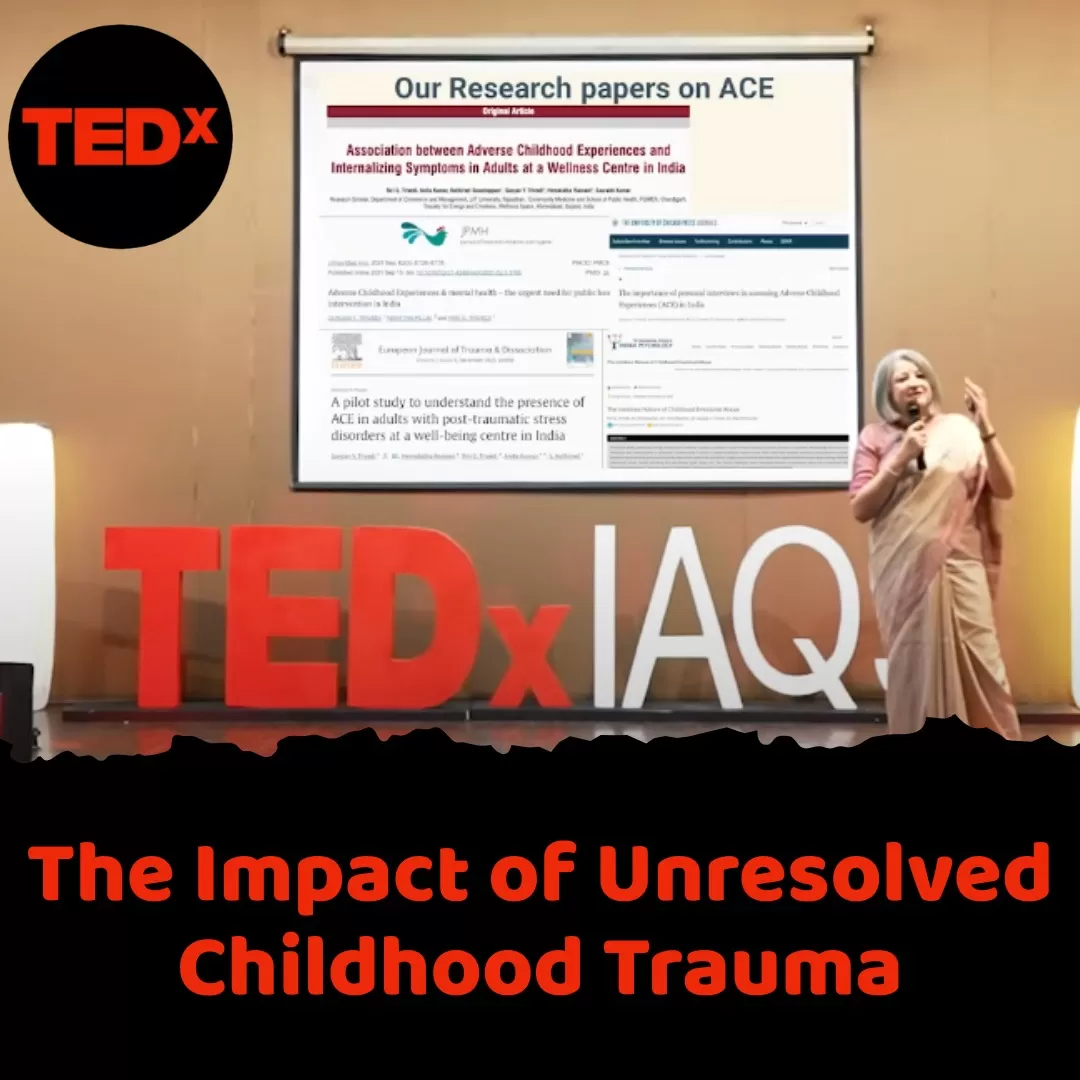
Childhood trauma research, coaching and training at Wellness Space, Ahmedabad, India At Wellness Space, over the past several years, we have worked on understanding the root causes that lead to internalizing and externalizing symptoms.  One of the core issues or root causes is exposure to repeated trauma of high intensity during childhood.  Despite the extensive global evidence, there is limited childhood trauma research in India.  Hence, we decided to pursue it.  At the moment, we have extensive published evidence supporting the role of childhood trauma as a significant risk factor in several internalizing issues (Such as depression and anxiety, insomnia,

Childhood trauma research in India at Wellness Space (Update: Jun ’26)2026-05-23T17:09:34+05:30

Evidence on Adverse Childhood Experiences, dissociative disorders, and attachment

This article provides a brief overview on the outcomes of ACEs (Adverse Childhood Experiences) with respect to dissociative symptoms and attachment disorders. Background:  Adverse Childhood Experiences, extreme stress, and dissociative symptoms There is considerable evidence regarding the relationship between childhood abuse or neglect and dissociation symptoms in adulthood with an earlier age of onset, as well as a longer duration of abuse and parental abuse significantly predicted higher dissociation scores. The relationship between ACEs and dissociation is fully mediated by mentalization; this means that the important predictive factor for dissociation is not if you have been abused as a child,

Evidence on Adverse Childhood Experiences, dissociative disorders, and attachment2026-04-30T18:05:08+05:30
Go to Top