
What Happens in a Past Life Regression Therapy Session — and How Is the Healing Process Measured?
If you have never experienced Past Life Regression (PLR), you may wonder what actually happens during a session. Will you remember what happened? Will you be able to return to the present? What does the therapist look for during the process? And perhaps most importantly, how do you know whether the session is actually helping?
At Wellness Space, Past Life Regression (PLR) therapy sessions are conducted by Dr Riri G Trivedi and other therapists trained in the Past Life Regression Module. A typical session lasts approximately 1.5 to 2 hours and is primarily therapeutic. The exact process can vary depending on the therapist, the concern being explored and the way the individual responds to the regression.
The session is not simply about finding a past-life story. The focus is on exploring an experience, understanding its relationship with a present-life concern, working with the associated emotional charge, and integrating the resulting understanding into the present life.
1. Understanding the concern and the process
The session begins with a conversation about the concern that has brought you to PLR.
This is also the time to understand how regression works and discuss any apprehensions you may have. People commonly wonder:
- Will I be able to come back after going into a past life?
- Will regression affect my present-life relationships?
- Will I remember what I say or experience?
- What if I don’t see anything?
- What if I experience something I don’t understand?
Discussing these questions beforehand helps establish an understanding of the process before the regression begins.
The therapist also identifies the issue or pattern that is to be explored. This gives the session a therapeutic direction rather than making the regression simply an attempt to discover an interesting past-life experience.
2. Relaxation and entering a trance state
You are then guided into a deeply relaxed, meditative state, commonly referred to as a trance.
Within the Wellness Space framework, this process is intended to quiet the logical, conscious, judgmental and over-analytical mind and facilitate access to the subconscious. Experiences at this level may be represented through images, sensations, emotions and feelings rather than through the kind of logical narrative used in everyday thinking.
You remain involved in the process throughout. The purpose is not to lose control, but to allow experiences that may ordinarily remain outside conscious awareness to become accessible for exploration.
3. Accessing the experience
There is no single way in which a regression has to unfold.
Depending on the therapist and the concern, a guided imagery process may be used to access an experience. In other cases, a strong emotion, physical sensation, or other significant experience may serve as the link or bridge to the material being explored.
What emerges can also vary considerably from person to person. Someone may experience a sequence of events quite vividly, while another person may experience only fragments, images, sensations, emotions or a sense of knowing.
The objective is not to force a particular experience or to make the subconscious conform to a predetermined story.
4. Exploring the emotional charge
Once an experience has been accessed, the therapist works with it in relation to the concern identified at the beginning of the session.
An important part of this process is the emotional charge associated with the experience.
Sometimes a person may know intellectually that something happened but continue to experience a strong emotional or physical response when the subject is triggered. Regression work may involve revisiting the experience in a way that allows the associated emotions, sensations and meanings to be explored.
The aim is not simply to remember what happened. It is to work with what remains unresolved about the experience.
5. Connecting the experience with the present
The therapist then explores whether and how the experience may relate to the person’s present life.
Depending on the concern, this may involve exploring:
- An emotionally charged or traumatic experience
- Body memories or unexplained physical sensations
- Recurring relationship patterns
- Repeating emotional or behavioural patterns
- Experiences that appear difficult to understand through current-life memories alone
- The roots of a fear or phobia
This is where regression becomes therapeutic rather than simply experiential. The question is not only “What happened?”, but also “How might this relate to what I am experiencing now?”
6. Working with the experience
Identifying an experience is not necessarily the end point of the session.
Once the relevant emotional material has been accessed, the therapist works with it through processes of healing, release and transformation. The intention is to reduce or nullify the impact that the unresolved experience may have on the person’s present life.
This may involve allowing emotions to be experienced and released, gaining a different understanding of the event, separating from an old emotional response, or identifying lessons and insights to carry forward.
The process is therefore not about remaining immersed in the past. It is about changing the relationship with what has been experienced.
7. How do you know whether something is changing?
One question that naturally arises in any therapeutic process is: How do we know whether the intervention is working?
Some indications come directly from the person. Changes in emotional intensity, physical sensations, thoughts, perceptions and responses can provide important feedback during and after the session.
There can also be observable physiological changes.
During therapeutic work, changes may occur in physiological aspects such as breathing rate, blood flow, and muscle tension. A trained therapist may notice some of these changes through observation. However, physiological changes can also be measured more objectively.
One approach explored at Wellness Space is Heart Rate Variability (HRV) and its associated measure of heart rhythm coherence.
HRV and coherence
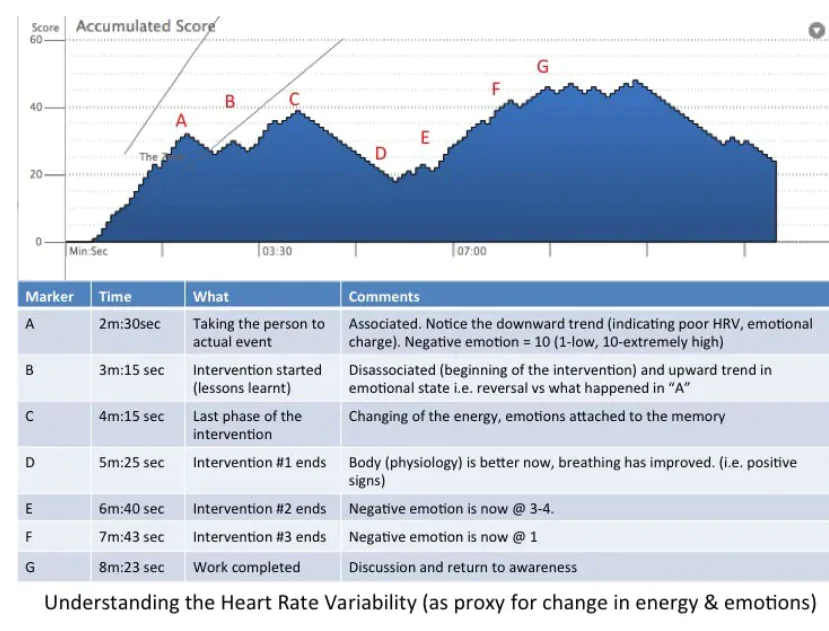
HRV measures variations in the time interval between heartbeats. In the measurement approach described by Wellness Space, continuous inter-beat intervals are recorded through a pulse sensor and analysed to determine patterns of coherence. The system provides coherence levels and an accumulated coherence score throughout the session.
The usefulness of this measurement lies in providing a physiological record alongside the person’s subjective experience.
For example, during a period of strong emotional activation, physiological patterns may change. As the emotional charge is worked through and the person reaches a greater sense of resolution, the physiological pattern may also change. Wellness Space has described a session in which coherence increased as the emotional charge reduced and the associated learning was completed.
This does not mean that an HRV or coherence measurement can, by itself, prove that a past-life experience is objectively real or that healing has definitively occurred. Rather, it can provide an additional physiological indicator of changes occurring during the therapeutic process.
Actual measurements and interventions:
The visual shows the results. As you can see, the change in coherence (as visible in the Accumulated score) occurred during a period when high (negative) emotional charge was being released or worked on. When the learnings were completed (usually this is marked by a reduction in emotional charge), the overall coherence (and hence accumulated score) increased.
8. Integration into the present life
The final stage of the session is integration.
The purpose of regression is not simply to revisit the past and return with a story. The experience is brought back into the context of the person’s current life.
The therapist works with the insights and understanding that have emerged, reinforces useful perspectives, and may use future-pacing to help the person imagine responding differently to relevant situations going forward.
The focus is therefore on what can change now.
What might you experience during a session?
There is no single way to experience Past Life Regression.
Some people may experience vivid scenes or a strong sense of being somewhere else. Others may experience isolated images, emotions, bodily sensations or fragments of an experience. Some may experience very little visually but have a strong emotional or sensory response.
The experience can also be accompanied by the logical mind questioning what is happening. You may wonder whether something you experienced was imagined, remembered from something previously seen or read, or genuinely connected to another experience.
The therapeutic process does not require every experience to be immediately explained or intellectually resolved. The focus is on exploring the experience and understanding its relevance to the concern being addressed.
What is the purpose of the session?
A Past Life Regression session at Wellness Space can therefore be understood as a process of:
Identifying the concern → accessing relevant experience → exploring emotional charge → understanding its connection with the present → healing and transformation → measuring or observing changes → integrating the learning into present life.
The goal is not simply to discover who you may have been.
It is to explore whether an unresolved experience may be connected with something you are experiencing today — and, where appropriate, to work towards healing, release and a different way of relating to it.
Book a Session
If you have a recurring fear, emotional pattern, relationship difficulty, unexplained experience or concern that you feel may have deeper roots, Past Life Regression may be explored as one therapeutic approach.