How to Forgive Someone Who Hurt You – When Being Told To Isn’t Enough
Forgiveness is a process, not a command. Relationship Dialogue in hypnotherapy, for people who are still in your life. Wellness Space, Ahmedabad.
Nobody died, so nobody calls it grief.
The person is still alive. You may still see them at family gatherings, still take their calls, still have no way to raise what happened. And everyone around you has an instruction ready. Adjust. Let it go. Forgive.
You may want to. That is what makes it so painful. You can believe in forgiveness completely, understand every reason for it, decide sincerely that you have done it — and still feel the same thing rise in your chest when their name comes up.
That is not a failure of character. It is a sign that forgiveness was asked of you before the thing underneath it had been dealt with.
Forgiveness is not something you can decide. It is something that becomes possible.
This page is about what makes it possible. For losses through death, see grief therapy and Relationship Dialogue
Why forgiveness can’t be done on command
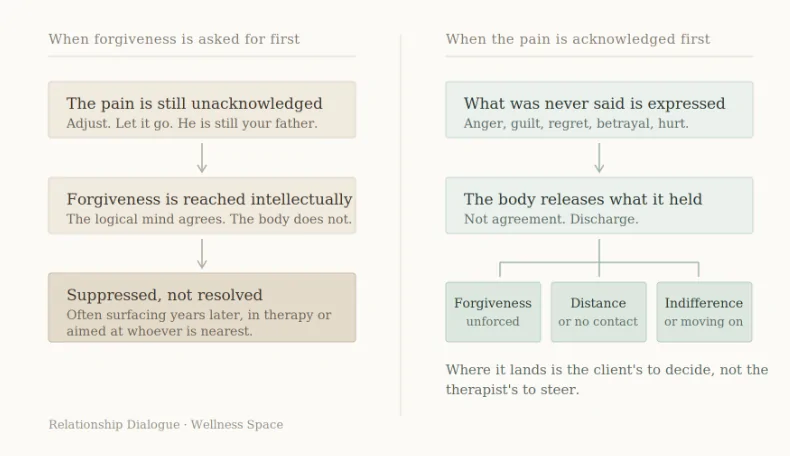
Forgiveness is not a single act performed on request. It is a process — a central point in our book, What Happened to Me? vs What’s Wrong with Me? — and one that shapes how we work. It becomes possible once the pain underneath has been acknowledged and released. Before that point, a person can comply. But the compliance happens in the logical mind alone. The body is not consulted and does not change.
Telling someone that only forgiveness will heal them places an enormous burden on them, particularly if they were badly hurt. When the instruction comes from elders, religious figures or spiritual teachers, what results is forced forgiveness, and it does nothing for the body. Forgive and forget lands as dismissive to anyone who has actually been through it.
Forgiveness reached before the pain is healed is an agreement, not a release. The mind signs it. The body never sees it.
We see this regularly. Deeply spiritual clients have told us with complete sincerity that they forgave someone years ago — and then, taken back into the event during therapy, experienced a sudden purging of emotion that had been sitting untouched the whole time. Their forgiveness was real. It simply had not reached the place where the injury was stored.
This is the difference between forgiving in your head and forgiving in your body. Reasoning can reach the first. Only the second ends the anger — and only the second is what people mean when they say they want to forgive.
What forgiveness looks like when it is real
It is quieter than people expect.
There is usually no moment of declaration, no conversation with the other person, no scene. What clients describe instead is an absence: the name comes up and nothing happens. The anniversary passes and they notice it late. The next family function is survivable. The weight they had stopped noticing because they had carried it so long is simply not there.
Real forgiveness also asks nothing of the other person. No apology, no admission, no acknowledgement, no contact. It is entirely yours, which is what makes it available even where the relationship is not.
Forgiveness is not reconciliation
Collapsing the two keeps people away from help they could use.
Forgiveness is the release of what you are carrying. It happens inside you. Reconciliation is resuming a relationship, which needs their behaviour to change — and you are entitled to conclude it never will.
You can forgive someone and never speak to them again. You can stay cordial with someone you have not forgiven. Neither is hypocrisy.
This distinction is why forgiveness is more available than most people think. You are not being asked to let anyone back in.
What Relationship Dialogue is
A single-session protocol for unfinished business in a relationship. In a guided state, the person is brought in and cannot interrupt or retaliate. You say what you never could, the body releases what it held, and a positive state is built up until you can meet them from inside it.
It works with or without hypnosis; we recommend it under hypnosis, as taught in Module 2. Full protocol on our grief therapy page.
Who this is for
- An estranged parent — no contact for years, or contact that costs you something every time
- A spouse you are staying married to, carrying something from a decade ago
- A sibling, after a property or inheritance dispute
- In-laws, where the pressure to keep the peace falls on you
- An ex-partner, where the divorce is finished and the anger is not
- A friend whose betrayal you have never named to anyone
- An employer or mentor who damaged your confidence in a way that outlasted the job
- A parent who has since died, where what you carry is anger rather than loss
That last case causes confusion. If what you carry is loss, the grief application is the right page. If it is anger their death has left permanently unaddressed, this one is.
What our data shows
Wellness Space has logged 497 Relationship Dialogue sessions. Distress is recorded on the SUDS scale (0–10) before the session, immediately after, and again at follow-up more than a month later. 289 sessions have a complete before-and-after record.
Across those 289, distress fell from a mean of 8.6 to 2.2 — a reduction of about 75%, statistically significant and with a very large effect size (Cohen’s d = 2.89). In the 149 sessions with follow-up beyond a month, scores continued to fall, from 2.2 to 1.4. The improvement deepened rather than faded.
The effect holds across relationship types. Work on fathers produced a 76% reduction, mothers 73%, spouses 75%, mothers-in-law 71%, siblings 70%.
And here is what people were actually after. At the start of each session, clients name the emotion they want in place of what they are carrying:
| What clients wanted instead | Share of sessions |
| Peace or calm | 45% |
| Happiness or joy | 19% |
| Love | 18% |
| Neutrality, detachment, feeling unaffected | 14% |
| Confidence | 10% |
| Acceptance | 7% |
| Forgiveness | 4% |
Clients often named more than one, so the column exceeds 100%.
Almost nobody walked in asking to forgive. They asked for peace.
That is worth sitting with, because it says something about how forgiveness actually arrives. People who are hurting do not experience forgiveness as the goal — they experience it as another demand. What they want is for the weight to lift. And when it does, many find that forgiveness has quietly become possible without ever having been aimed at.
Which is the point of this page. Stop chasing forgiveness and deal with what is underneath it, and forgiveness stops being something you have to manufacture.
What thirty years of research says
Our position is not an outlier. It is what the forgiveness literature has been finding since the 1990s: forgiveness works, and it works when it is worked through.
The largest review of the field — a meta-analysis of 54 studies covering more than 2,300 participants in the Journal of Consulting and Clinical Psychology — found that structured forgiveness interventions significantly reduce depression and anxiety. Its most useful finding here concerns dose: the longer and more structured the intervention, the larger the effect. Brief encouragement to forgive achieves very little.
The trial most relevant to people carrying serious hurt makes the same point about time. Reed and Enright worked with women who had experienced spousal emotional abuse, recording significant reductions in depression, anxiety and post-traumatic stress. Two details matter. The intervention ran for an average of around eight months. And participants had been permanently separated from the abusive spouse for at least two years — the work was done after safety was established, never during.
Forgiveness has also produced measurable change where the body is doing the reporting: anger, mood and relapse vulnerability in substance-dependent inpatients, and psychological outcomes in patients with coronary artery disease.
Nothing in this literature supports forgiveness as a quick instruction. All of it supports forgiveness as something reached.
A note on what Relationship Dialogue is and isn’t. The studies above test forgiveness therapy — a structured, months-long intervention with forgiveness as its stated goal. Relationship Dialogue is not that, and we do not describe it as such. It is a release protocol. We cite this literature because it establishes the thing we rely on: that forgiveness follows process and never instruction.
Forgiveness in Indian families
Indian traditions carry real wisdom about forgiveness. Kshama sits among the virtues. In the Jain tradition, micchami dukkadam makes the asking of forgiveness an annual practice — a genuinely remarkable thing, an entire culture with a scheduled day for repair.
The difficulty is not the value. It is the timing, and who is asked.
Cultural forgiveness is often required to be immediate and public, while the emotion underneath is neither. And in most joint families the expectation lands unevenly: on the daughter-in-law rather than the son, on the child rather than the parent, on whoever has least standing in the room. Izzat and family harmony are held together by particular people absorbing particular things, and those people are rarely asked whether they mind.
What is called forgiveness in these conditions is usually suppression. It resurfaces years later, aimed at whoever is nearest.
Relationship Dialogue works alongside these values rather than against them. It gives the emotion somewhere to go first — privately, without a confrontation that would cost you more than it returned, and without requiring the family to acknowledge anything. Many clients say nothing at all afterwards. They simply find the next visit survivable, and then, later, unremarkable.
That is kshama arriving the way it was meant to. Not performed on a deadline, but reached.
For mental health professionals
Relationship Dialogue is taught across its applications, with supervised practice, in Module 2 – Hypnotherapy Training in India within the Evidence-based Psychotherapy Program.
Two principles govern the living-relationship application. The client is told before the session begins that the other person will not change. And we steer toward neither forgiveness nor reconciliation — therapists practising in Indian family systems carry the same cultural expectations as their clients, and steering toward a particular ending undoes the work.
The stages that make the protocol safe — assessment, containment, and knowing when not to proceed — are the ones that cannot be picked up from a description.
[Explore evidence-based hypnotherapy training in India →]
FAQs
I already forgave them years ago. Why do I still feel angry?
This is one of the most common things we see, and it is not a failure on your part. Forgiveness reached through reasoning — because it was the right thing, the spiritual thing, the thing that keeps the family together — can be entirely sincere and still leave the original injury untouched in the body. You forgave in your head. The place where the hurt is stored was never reached. Clients who were certain they had forgiven often find a great deal still waiting when they are taken back into the event.
How long does it take to forgive someone?
There is no schedule, and anyone giving you one is guessing. What the research shows is that it takes process rather than time alone — people can carry something for thirty years without moving, and then shift substantially in a single session once the pain is actually addressed. What matters is not how long you wait but whether anything is done with what you are holding.
Do I have to forgive them?
No. We will not ask you to, and forgiveness is not how we measure whether the work succeeded. Some clients arrive there once the weight is off. Others reach indifference, or clear-eyed non-forgiveness, or a decision to go no-contact they can finally act on without guilt. All of those are finished work.
My family, or my guru, says I should forgive. Does this contradict that?
No. It puts it in the right order. Forgiveness asked for before the pain is acknowledged produces agreement, not healing. This work deals with the pain first, which is what makes any forgiveness that follows real rather than performed.
What if they were abusive?
Then forgiveness is not required and may never come, and that is a legitimate ending. Where abuse is ongoing, safety comes first and this is not the first step. Where it is historical, the work addresses what you still carry — with no requirement to forgive, excuse or resume contact.
Do I have to talk to them?
No. Nothing is required of you outside the session and nothing is required of them. They need not know it happened.
Will it change the relationship?
It changes what you carry, not the other person’s behaviour, and we say so before the session. Clients often report things going differently anyway once their own reaction changes — but that is a by-product, not a promise.
Is this couples therapy?
No. Couples therapy works with both people on the present relationship. This is one-person work on what you carry — which is why it also works where the other person would never attend anything.
What if they have died?
Then the grief application is likely the better fit — unless what you carry is anger rather than loss.
References
- Trivedi, G. Y., Trivedi, R. G., & Ramani, H. (2026). What Happened to Me? vs What’s Wrong with Me? Ebury Press, Penguin Random House India. See “The Pressure to Forgive.”
- Pandya, N., Trivedi, R. G., Ramani, H., & Trivedi, G. Y. (2025). Relationship Dialogue for Grief Management. The International Journal of Regression Therapy, Issue 35. Full paper
- Wade, N. G., Hoyt, W. T., Kidwell, J. E. M., & Worthington, E. L., Jr. (2014). Efficacy of psychotherapeutic interventions to promote forgiveness: A meta-analysis. Journal of Consulting and Clinical Psychology, 82(1), 154–170.
- Reed, G. L., & Enright, R. D. (2006). The effects of forgiveness therapy on depression, anxiety, and posttraumatic stress for women after spousal emotional abuse. Journal of Consulting and Clinical Psychology, 74(5), 920–929.
- Lin, W. F., Mack, D., Enright, R. D., Krahn, D., & Baskin, T. W. (2004). Effects of forgiveness therapy on anger, mood, and vulnerability to substance use among inpatient substance-dependent clients. Journal of Consulting and Clinical Psychology, 72(6), 1114–1121.
- Waltman, M. A., Russell, D. C., Coyle, C. T., Enright, R. D., Holter, A. C., & Swoboda, C. M. (2009). The effects of a forgiveness intervention on patients with coronary artery disease. Psychology & Health, 24(1), 11–27.