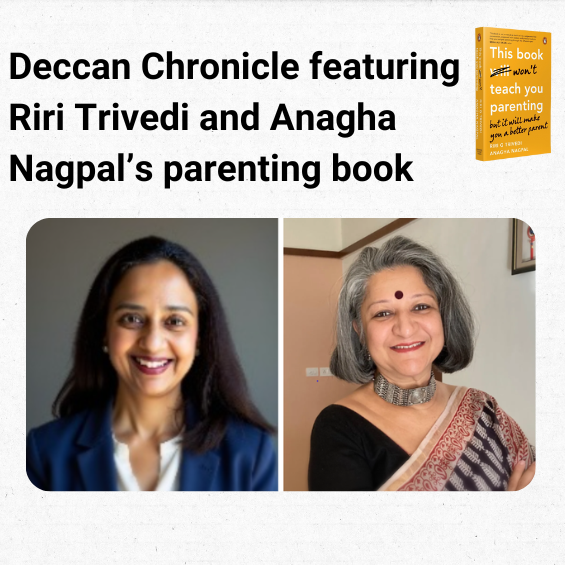
Deccan Chronicle featuring Riri Trivedi and Anagha Nagpal’s parenting book: This Book Won’t Teach You Parenting – May, 2025

Psychotherapist Riri G. Trivedi and parent educator Anagha Nagpal have co-authored a book that explores Indian parenting through the lens of healing childhood trauma, encouraging self-reflection, and breaking negative patterns. The book also highlights ways parents can model calm, regulated responses to stress for their children. It was featured in The Deccan Chronicle’s ‘Bookmark’ segment, where Neil Pate curates and reviews notable new releases.   The article outlines the book’s key themes and explains how it equips readers with practical tools to navigate the complexities of modern parenting. The editor adds that Trivedi and Nagpal offer a “parenting compass” for

Deccan Chronicle featuring Riri Trivedi and Anagha Nagpal’s parenting book: This Book Won’t Teach You Parenting – May, 20252026-01-29T12:11:59+05:30

Publication – How the parents’ childhood trauma influences Parenting Style

How the parents' childhood trauma influences Parenting Style Vipasha Naik, Dr Gunjan Trivedi,  Riri G Trivedi (Society for Energy & Emotions, Wellness Space, Ahmedabad, India) Publication - Navigating Generational Patterns: How Childhood Trauma Shapes Authoritative Parenting Practices in Indian Families ABSTRACT Background: Adverse Childhood Experiences (ACEs) are defined as early childhood exposure to maltreatment and household dysfunction. Research indicates a potential intergenerational influence of parental ACEs on their children’s well-being. Objective: This study investigated the association between parental ACE scores and the authoritative parenting style, which was considered the ideal style among the four parenting styles. Methods: Parents (N=130 ) seeking therapeutic help at a wellness center

Publication – How the parents’ childhood trauma influences Parenting Style2024-08-16T16:12:20+05:30

SPU 2024-Presentation on Examining the Impact of Parental Resilience and Childhood Trauma on Parenting Styles

The following two abstracts will be presented (Examining the Impact of Parental Resilience and Childhood Trauma on Parenting Styles) at the SPU  National Conference in Anand   Abstract 1: Examining the Impact of Parental Resilience and Childhood Trauma on Parenting Styles Presenter: Dr Gunjan Y Trivedi Co-Presenter:Riri G Trivedi, Neha Pandya, Parishi Thakore, Vipasha Naik Background: Resilience plays a key role in internalization and externalization. Similarly, there is significant evidence about the role of childhood trauma in internalization and externalization issues. However, there is limited literature on the link between parenting style (a behavioral trait) and the influence of parenting

SPU 2024-Presentation on Examining the Impact of Parental Resilience and Childhood Trauma on Parenting Styles2024-03-07T18:35:01+05:30

Complex Post Traumatic Stress Disorder in India – Frequently Asked Questions (Childhood Trauma)

1.1 Frequently asked topics on childhood trauma – PTSD or Complex PTSD? The human approach to understanding and addressing trauma is evolving; honestly, we haven’t yet figured out all the implications of trauma.   There are some important considerations: There is a difference between PTSD and Complex PTSD (The video explains this further) The Diagnostic and Statistical Manual of Mental Disorders, 5th edition(DSM-5), a handbook often used by psychiatrists and psychologists, does not currently acknowledge complex PTSD as a separate condition. PTSD (Post Traumatic Stress Disorder), a condition covered under DSM-IV in anxiety disorders, is covered in DSM-V. However, in DSM-5 it was called

Complex Post Traumatic Stress Disorder in India – Frequently Asked Questions (Childhood Trauma)2024-07-17T13:46:52+05:30

Publication – Bhramari (humming) as stress buster

Humming (Simple Bhramari Pranayama) as a Stress Buster: A Holter-Based Study to Analyze Heart Rate Variability (HRV) Parameters During Bhramari, Physical Activity, Emotional Stress, and Sleep A brief note on the article: Recent research by Gunjan in our team identified that Bhramari Pranayama (simple practice, without any mudras or hand gestures) could profoundly benefit heart signals (resulting in heart-brain coherence that improves physical and mental health).  This was validated by comparing the "heart signals" (known as heart rate variability analysis or coherence) during various activities (physical activity, emotional stress, sleep, and Bhramari), and the comparison demonstrated the outcome.  You

Publication – Bhramari (humming) as stress buster2024-08-14T11:43:19+05:30
Go to Top