Pareto (80-20 rule) #2: Applying pareto for financial planning

Applying Pareto for financial planning Last week, we discussed the role of the Pareto Principle (80/20 rule), which suggests that around 80% of the outcomes or effects come from a relatively small portion (around 20% of inputs). Today, we review how the approach is evident in equity investing through a quick study of the top 10 large-cap mutual funds. First, let's use Pareto to establish some basic guidelines.  Investing 80% of your money into equity is more prudent during the early phase of your earning career. As you approach retirement, the numbers can be reversed, i.e. 80% of your funds

Pareto (80-20 rule) #2: Applying pareto for financial planning2024-03-25T12:17:34+05:30

Inner Child Integration and Emotional Neglect in Complex PTSD Recovery

Bridging the Gap: Inner Child Integration and Emotional Neglect in Complex PTSD Recovery To uncover the root causes of trauma, one crucial aspect that often gets overlooked is the role of emotional neglect experienced during childhood. Our ongoing research, focused on individuals assessed for Complex PTSD, has provided valuable insights into the profound impact of emotional neglect and its connection to long-term trauma. This article offers some unique insights from several assessments and personal interviews of adults who present with the symptoms of Complex PTSD (Post Traumatic Stress Disorder) Assessment: Worldwide, DSM-V (The Diagnostic and Statistical Manual of Mental

Inner Child Integration and Emotional Neglect in Complex PTSD Recovery2025-05-21T12:35:46+05:30

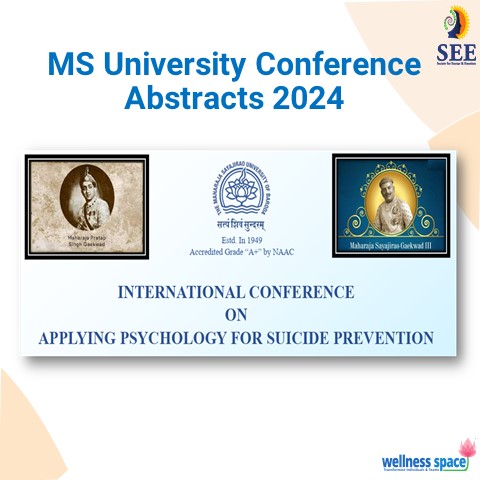
International Conference on applying Psychology for Suicide Prevention-Our Abstracts

Wellness Space team is going to present total of 3 abstracts (please see below) at the conference.  Please join us. Abstract #1 -Effective Strategies for Suicide Risk Assessment and Intervention: A Practical Guide Utilizing the ASQ Tool for Screening Background: Suicide behaviour (including suicide thoughts, plans, and history of attempts) requires specialised screening and intervention. Suicide is a primary cause of death in the young population of India (Age <39), and hence, psychologists and psychotherapists need a framework to facilitate better screening and recovery. Objective: The study, based on the ASQ (Ask Suicide Screening Questions) toolkit, provides

International Conference on applying Psychology for Suicide Prevention-Our Abstracts2025-05-21T15:23:00+05:30

Pareto (80-20 rule) #1: Small Changes, Big Impact: Integrating the Pareto Principle into Your Daily Routine

This was an article given to Divya Bhaskar, Ahmedabad (Feb 19, 2022) Context: We use Pareto ideas across our daily work, even in mental health.  For example, index trauma (covered in Module 6) is based on the 80/20 principle.  Other examples in daily life include equity portfolio planning and financial well-being. Please read the entire article below in English: The Pareto Principle, also known as the 80/20 rule, suggests that a significant portion, often around 80%, of effects come from a relatively small portion, usually around 20%, of causes. In simpler terms, focusing on a few key areas can often

Pareto (80-20 rule) #1: Small Changes, Big Impact: Integrating the Pareto Principle into Your Daily Routine2024-03-25T12:17:23+05:30

NAOP24-Presentation on “resilience & depression”, “childhood trauma & suicide behavior”

The following two abstracts will be presented (The Role of Resilience in moderating depression, Childhood Trauma & suicide behaviour) at the NAOP national convention in Vishakhapatnam on Feb. 15, 2024).   Abstract ID NAOPABST000312: The pivotal role of resilience and perceived social support in moderating depression: A structural equation modelling approach Presenter: Dr Gunjan Y Trivedi Co-Presenter: Neha Pandya, Parishi Thakore, Dr Hemalatha Ramani Background: Resilience is the capacity to adjust, recover from hardship, stress, or challenging life experiences, and move on and prosper. It entails using sensible coping strategies, preserving well-being, and even becoming more resilient in facing difficulties.

NAOP24-Presentation on “resilience & depression”, “childhood trauma & suicide behavior”2024-02-08T10:47:05+05:30
Go to Top